How Much Does a Fertilizer Double Granulator Machine Cost?

The double roller press granulator is an important fertilizer production machine for manufacturers who need efficient granule production with controlled investment. Many fertilizer producers, mineral fertilizer manufacturers, and project investors pay close attention to fertilizer granulation machine cost because equipment selection directly affects the total fertilizer production budget.

A suitable fertilizer granulation system should match raw material characteristics, production capacity, product requirements, and factory conditions. The fertilizer equipment price depends on machine configuration, production process design, supporting equipment, and customer requirements.

For companies planning a fertilizer manufacturing project, understanding the factors affecting fertilizer granulator price helps them select suitable fertilizer production equipment and build a practical fertilizer production system.

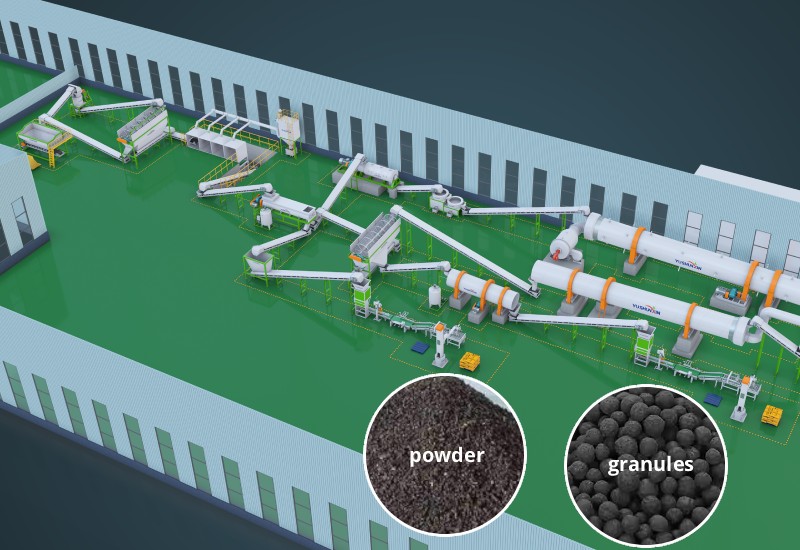
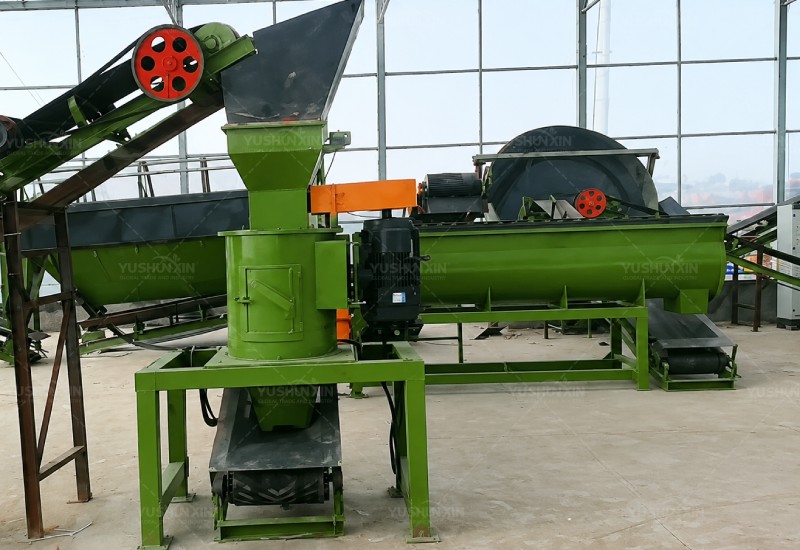
double roller granulation plant

What Factors Affect Fertilizer Granulator Machine Price?

The fertilizer granulation machine cost depends on several factors instead of one fixed price.

Production Capacity

Production capacity is one of the main factors affecting fertilizer equipment quotation. Small fertilizer manufacturers may select compact fertilizer machinery for initial production, while large fertilizer factories require higher-capacity fertilizer manufacturing systems.

A larger fertilizer production capacity usually requires stronger motors, larger feeding systems, and more supporting equipment.

Raw Material Characteristics

The raw material type influences fertilizer production equipment selection.

Common materials used in fertilizer production include:

  • NPK compound fertilizer materials
  • Potassium fertilizer materials
  • Mineral fertilizer powder
  • Bentonite materials
  • Other dry fertilizer ingredients

Different materials have different processing requirements. Therefore, fertilizer manufacturers should select granulation equipment according to material properties.

Equipment Configuration

The fertilizer production machine price also depends on machine structure, spare parts, electrical components, and additional systems.

A complete fertilizer production solution may include feeding equipment, crushing machines, mixers, granulators, screening machines, and packaging systems.


How Does a Double Roller Press Granulator Work in Fertilizer Production?

The double roller press granulator uses extrusion granulation technology to transform powder materials into fertilizer granules.

During the fertilizer manufacturing process, prepared materials enter the feeding system and move between two pressing rollers. The pressure created by the rollers compresses powder materials into compact shapes.

After extrusion, the fertilizer granules enter the crushing and screening procedure. The screening system separates qualified granules and returns unsuitable materials for further processing.

The complete fertilizer production process usually includes:

  • Raw material preparation
  • Material mixing
  • Feeding
  • Roller extrusion
  • Granule shaping
  • Screening
  • Packaging

This fertilizer production technology helps manufacturers process dry materials efficiently and reduce additional drying requirements.


What Raw Materials Can Use a Fertilizer Press Granulator?

The double roller press granulator is suitable for many dry fertilizer materials.

Common applications include:

Compound Fertilizer Production

NPK fertilizer manufacturers can use extrusion granulation technology to process mixed fertilizer ingredients into commercial granules.

Mineral Fertilizer Production

Mineral fertilizer producers can process powder materials into easier-to-store and transport fertilizer products.

Potassium Fertilizer Production

Materials such as potassium chloride and potassium sulfate can be processed through suitable fertilizer granulation procedures.

The correct raw material preparation process improves granule quality and production stability.


What Equipment Is Needed for a Complete Fertilizer Production System?

A fertilizer manufacturing plant usually requires multiple machines working together.

The crushing machine prepares raw materials before production. The mixer ensures different ingredients are evenly distributed. The fertilizer granulator completes the main granule-making procedure.

After granulation, screening equipment separates qualified fertilizer particles. Packaging machinery helps fertilizer manufacturers prepare finished products for transportation and sales.

A complete fertilizer production equipment system depends on:

  • Production capacity
  • Raw material conditions
  • Fertilizer formula
  • Factory space
  • Investment budget

A suitable fertilizer manufacturing design helps companies achieve stable production and better cost control.


Is a Double Roller Press Granulator Cost-Effective for Fertilizer Producers?

Many fertilizer manufacturers compare fertilizer machine price and long-term operation benefits before purchasing equipment.

The double roller press granulator provides several practical advantages.

Lower Production Complexity

The dry granulation process reduces the number of production stages and simplifies fertilizer manufacturing management.

Reduced Energy Consumption

Because the process does not require a large drying system, fertilizer producers may reduce energy-related operation costs.

Flexible Fertilizer Production Application

The equipment can support different fertilizer production projects according to raw materials and product requirements.

Suitable Investment Choice

For companies that need fertilizer production machinery with controlled investment, extrusion granulation provides a practical option.


How Should Buyers Choose Fertilizer Production Equipment?

Before purchasing fertilizer machinery, buyers should evaluate several aspects.

The fertilizer producer should consider:

  • Target fertilizer production capacity
  • Required fertilizer granule size
  • Raw material characteristics
  • Production process design
  • Equipment investment budget
  • Future expansion requirements

A reliable fertilizer equipment supplier should provide a complete production solution rather than only a machine quotation.

The correct fertilizer production system combines suitable equipment selection, reasonable process design, and technical support.


Conclusion

The fertilizer granulator machine cost depends on production capacity, raw materials, equipment configuration, and complete fertilizer manufacturing requirements.

For mineral fertilizer producers, NPK manufacturers, and fertilizer project investors, choosing suitable fertilizer production equipment helps create an efficient fertilizer manufacturing system with reasonable investment.

A professional fertilizer equipment manufacturer – Yushunxin provides fertilizer production machinery solutions according to different fertilizer project requirements.

For more details about fertilizer granulation equipment, please visit: https://www.mineralfertilizerproductionsolutions.com/product/double-roller-press-granulator/
How to Size a Rotary Drum Blender for Stable BB Fertilizer Production

When your BB fertilizer project moves toward continuous production, the mixer cannot be selected from capacity alone. Your raw granules, batching speed, formula changes and packaging rate all affect the result. A rotary drum blender for uniform BB fertilizer formulas works best when the complete line supplies and removes material at a balanced rate.

Granule Compatibility Comes Before Mixer Capacity

BB fertilizer commonly combines urea, DAP, MAP, potassium chloride and other finished granules. These are granular materials, so differences in particle size, density and moisture can influence how the blend behaves during conveying and storage.

Before selecting a mixer, compare the granule specifications of every ingredient. Similar particles move through the drum more consistently, while large differences can increase segregation after mixing. A continuous granular fertilizer blending machine cannot correct an unsuitable raw-material combination by extending mixing time alone.

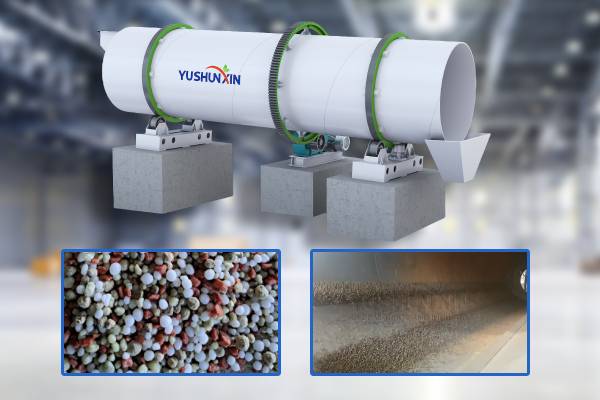
rotary drum blender for BB fertilizer production

Capacity Matching from Batching to Packaging

The target page lists rotary drum blender capacities from 5 to 40 TPH. Inside the rotating cylinder, lifting plates raise and release the granules repeatedly, creating a rolling and cascading flow. The slight drum inclination then moves the blend toward the outlet.

For a 30 TPH project, the batching system needs to maintain the correct ingredient ratios while the packing section handles the same finished flow. A capacity-matched rotary fertilizer blending system may include dynamic batching, belt conveying, drum mixing and twin-bucket packing.

The related 30 TPH bulk blending fertilizer plant configuration shows how a 20–40 TPH mixer can fit between automatic batching and packaging. This prevents a high-capacity blender from waiting for material or overloading the bagging section.

Carbon Steel and Stainless-Steel Options

Carbon steel can suit general fertilizer formulas, while stainless steel is available for corrosive materials, high-chlorine recipes or humid operating conditions. A stainless-steel drum mixer for commercial fertilizer plants also provides a smoother contact surface when frequent formula changes make residue control important.

Equipment material affects more than the drum body. Ask which parts contact the fertilizer and confirm the proposed material for the inlet, lifting plates, discharge section and connected conveyors.

Information Required for a Reliable Quote

Send the supplier:

  • Each fertilizer ingredient and granule specification
  • Required tons per hour and daily operating hours
  • Number of formulas and changeover frequency
  • Preferred equipment material
  • Bag weight, workshop dimensions and local voltage

These details support a rotary drum mixer configuration for bulk fertilizer production based on your real process. You can learn more before requesting the equipment list and layout:

https://www.mixedfertilizermachines.com/products/rotary-drum-blender/

Mango, Strawberry or Banana: How Raw Material Changes Freeze-Drying Equipment Selection

Mango, strawberry, and banana can all enter a commercial freeze-drying line. However, each fruit brings different processing requirements. Texture, slice shape, moisture, loading method, and pre-freezing conditions can change the equipment configuration.

A suitable Fruit Freeze Dryer Machine should match your actual raw material and production target. Therefore, the right solution starts with the fruit rather than one fixed machine configuration.

Why Does Raw Material Affect Freeze-Drying Equipment Selection?

Fruit freeze drying removes frozen water under vacuum through sublimation. The process helps maintain fruit shape, color, flavor, and porous structure.

However, different fruits behave differently during preparation and drying. Soft fruit needs gentle handling, while dense slices require suitable thickness and freezing conditions.

Slice thickness also affects drying time. Therefore, your factory should coordinate washing, cutting, pre-freezing, drying, and packaging as one production system.

HADOF can configure the line according to your raw material, required capacity, and available factory space.

What Does Mango Require From a Freeze-Drying Line?

Mango usually enters the line as peeled slices, cubes, or pieces. Therefore, consistent cutting helps create more uniform batches.

Thick mango pieces need more time for heat and moisture transfer. Consequently, processors should control piece dimensions before loading trays.

The preparation section may include washing, peeling, cutting, and sorting. A Bubble Cleaning Machine can support continuous fruit washing before further preparation.

Mango processors should also consider tray loading carefully. Even product distribution helps the freeze dryer handle each batch more consistently.

For commercial production, a Commercial Fruit Freeze Dryer can match different batch targets through chamber and shelf configuration.

Why Does Strawberry Need Gentler Handling?

Strawberries have a soft structure and delicate appearance. As a result, aggressive handling can damage the fruit before freeze drying starts.

Whole strawberries and sliced strawberries also create different drying requirements. Thin slices provide a shorter moisture path, while larger pieces need more drying time.

Gentle washing becomes especially important. The bubble cleaning process uses water movement and bubbles to remove dirt while reducing mechanical damage. This approach suits delicate fruits such as strawberries.

After preparation, operators should move strawberries through the line with limited unnecessary handling. Food Conveyors can connect processing sections and support smoother material transfer.

Therefore, strawberry projects often focus on gentle cleaning, careful transfer, uniform loading, and controlled pre-freezing.

How Does Banana Change Equipment Configuration?

Bananas usually require peeling and slicing before pre-freezing. Consistent slice thickness helps each tray reach a more uniform drying result.

Banana pieces can also become soft during preparation. Therefore, the line should reduce unnecessary transfer between processing stages.

Factories with higher throughput may need stronger material-flow planning. Conveyors, loading areas, and tray preparation sections can reduce repeated manual movement.

Pre-freezing also plays an important role. An Industrial Tunnel Freezer can support continuous freezing when the production scale requires higher throughput.

The final machine selection should still follow batch capacity, shelf area, and factory layout.

Mango vs Strawberry vs Banana: What Changes Most?

Fruit Main Processing Focus Equipment Consideration
Mango Consistent pieces Cutting, tray loading, drying capacity
Strawberry Gentle handling Mild washing, careful conveying
Banana Uniform slices Cutting, pre-freezing, material transfer

These differences do not require three completely different production lines. Instead, they change the configuration around the core freeze dryer.

For example, one factory may need more preparation equipment for mango. Another may focus more on gentle strawberry handling. Meanwhile, a banana processor may prioritize slicing consistency and pre-freezing capacity.

Which Equipment Usually Stays in the Complete Line?

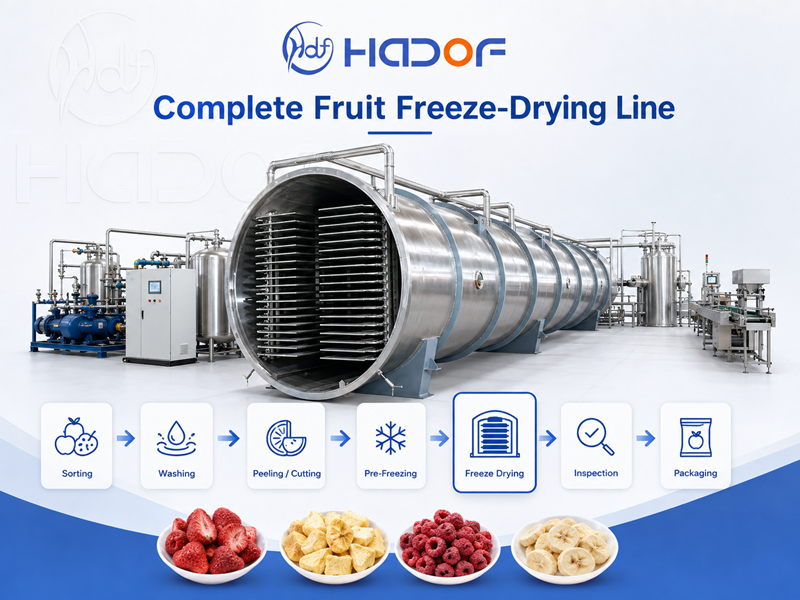
Although raw material changes the details, most commercial fruit lines follow a similar overall process:

Sorting → Washing → Peeling or Cutting → Pre-Freezing → Freeze Drying → Inspection → Packaging

The freeze dryer remains the central processing machine. Washing equipment prepares the fruit, while freezing equipment creates suitable frozen conditions before sublimation.

After drying, packaging protects the finished fruit from moisture. A Food Packing Machine can support the final packaging stage.

Therefore, buyers should consider the complete flow instead of viewing the freeze dryer as an isolated machine.

fruit freeze drying line

Does Production Capacity Matter More Than Fruit Type?

Both factors matter, but they influence different decisions.

Fruit type mainly affects pretreatment, slice size, handling, loading, and drying settings. Production capacity mainly affects chamber size, shelf area, refrigeration capacity, and material flow.

HADOF offers different industrial models for different production scales. The current fruit freeze dryer range includes HDF-30, HDF-50, HDF-100, and HDF-200 models. The listed capacities cover approximately 30 to 200 kilograms per batch.

However, customers do not need to prepare a complicated technical specification before asking for a solution. HADOF can match the equipment to your raw material, target output, and factory area.

How Should You Choose Between Different Fruit Projects?

Start with the product you actually want to sell.

For premium strawberry snacks, protect appearance and reduce rough handling. For mango pieces, focus on consistent dimensions and tray loading. For banana slices, coordinate cutting and pre-freezing carefully.

Next, match the required batch output with the freeze dryer capacity. Then, organize the washing, cutting, freezing, conveying, and packaging sections around that core machine.

This approach keeps the production line practical and avoids unnecessary equipment.

Build a Fruit Freeze-Drying Line Around Your Raw Material

Mango, strawberry, and banana can use the same freeze-drying principle. However, each material changes the preparation and equipment combination.

A well-planned project connects raw material characteristics with capacity and factory space. Therefore, the production line can support easier operation and more consistent output.

If you need a customized fruit freeze-drying solution, please visit the HADOF freeze dryer homepagehttps://www.freezehadof.com/


How to Build a Realistic Budget for a Granular Compost Fertilizer Plant

If you already have stable, finished compost and plan to convert it into commercial fertilizer granules, the price of a granulator alone cannot represent your total equipment investment. The actual budget depends on compost moisture, particle size, target capacity, granulation method, drying requirements, granule specifications and automation level.

Before comparing quotations, define the condition of your finished compost and the product you want to sell. YUSHUNXIN granular compost plant budget guidance can help you separate the essential granulation equipment from optional upgrades and site-related expenses.

Start with the Condition of Your Finished Compost

An industrial compost granulation project starts after fermentation is complete. The feedstock entering the line may be finished chicken manure compost, cow dung compost, biogas digestate compost, food-waste compost or a mixture of several composted materials.

Although these materials have already been composted, their processing characteristics can still differ significantly. Before selecting equipment, confirm:

  • Type and proportion of the finished compost
  • Available tonnes per day
  • Moisture content
  • Particle size
  • Bulk density
  • Fibre content
  • Presence of stones or other impurities
  • Additional minerals or nutrients
  • Required granule diameter
  • Target hourly production
  • Required bag size

Stable and mature compost normally enters the granulation stage more smoothly than uneven material containing large cakes, excessive fibres or unstable moisture.

If the compost is too coarse, it may need crushing before mixing. If it contains foreign materials, an additional screening stage can protect the granulator and improve final product consistency. These conditions affect both the equipment configuration and the project budget.

What Equipment Is Needed from Finished Compost to Bagged Granules?

For customers who already have finished compost, the granulation line normally begins with material feeding and conditioning rather than manure fermentation.

A typical process may follow this route:

Finished compost → feeding → crushing → screening → batching → mixing → granulation → drying and cooling if required → final screening → coating → weighing and packaging

The equipment budget for a 1–5 t/h compost pellet project may therefore include:

  1. Feed hopper
  2. Compost crusher
  3. Preliminary screening machine
  4. Batching system
  5. Fertilizer mixer
  6. Compost granulator
  7. Dryer and cooler
  8. Final rotary screener
  9. Return-material conveyor
  10. Coating machine
  11. Fertilizer weighing and packing machine
  12. Belt conveyors
  13. Dust collection
  14. Electrical control system
compost granules production process

Not every project needs every machine. The final configuration depends on whether the compost requires wet or dry granulation and whether the customer needs a basic line or a highly automated production system.

When reviewing a quotation, check whether it covers only the granulator or the complete process from finished compost feeding to packed fertilizer granules. Conveyors, platforms, electrical controls, dust collection and installation services may otherwise appear as additional costs later.

How Do Wet and Dry Granulation Affect the Investment?

Moisture is one of the main inputs for choosing the granulation route. When you compare wet and dry compost granulation budgets, evaluate the entire production line rather than comparing only the prices of different granulators.

Finished compost condition Suitable direction Main effect on the budget
Dry and finely crushed compost Double-roller extrusion May avoid conventional drying and cooling
Compost that accepts water or binder Disc granulation Economical granulator, but drying may be required
Medium- or large-scale continuous production Rotary drum granulation Requires a more complete drying, cooling and conveying system
Fibrous organic compost Stirring-tooth granulation Configuration depends on moisture and fibre content
Spherical premium granules required Granulation plus polishing Adds shaping and material-handling equipment

Dry granulation can shorten the production line

For dry extrusion, finished compost with moisture below approximately 20% can serve as an initial reference. The actual allowable moisture depends on the material’s flowability, fibre content and behaviour under pressure.

A dry granulation line may include:

Feeding → crushing → batching → mixing → roller extrusion → screening → packaging

Because the process does not normally add water, the line may not need a conventional rotary dryer and cooler. This can reduce the equipment quantity, fuel demand and workshop space.

However, dry extrusion does not suit every compost. Material that is too wet may stick to the rollers or feed unevenly, while excessive fibres may affect granule formation.

Wet granulation provides more shaping options

Disc, rotary drum and stirring-tooth granulators usually use moisture, steam or a binder to promote particle formation.

A wet granulation line may include:

Feeding → crushing → batching → mixing → granulation → drying → cooling → screening → coating → packaging

Because the process introduces liquid, the system normally requires drying and cooling. The budget may also need to cover a heat source, exhaust handling and additional conveyors.

Wet granulation generally gives the producer more flexibility in granule shape and formula design, but it also creates a longer process and higher energy demand.

The route decision can therefore balance material suitability, target granule quality, available utilities and equipment investment.

How Does Capacity Change the Reference Budget?

Capacity affects more than the size of the granulator. It also determines the specifications of the crusher, mixer, dryer, cooler, screener, conveyors and packaging machine.

Current reference equipment-budget ranges on the target page include:

  • Approximately USD 60,000–150,000 for selected 1–5 t/h configurations
  • Approximately USD 150,000–360,000 for selected 5–10 t/h configurations
  • Approximately USD 360,000–550,000 for selected 10–20 t/h configurations

These figures are reference ranges rather than fixed quotations. A compact dry extrusion line and a complete wet drum granulation line can have very different prices even when their nominal capacities are similar.

A dedicated 5 t/h compost pellet line equipment proposal illustrates this difference. A 5 t/h project may use multiple roller granulators, several disc granulators or a rotary drum system. Each route creates a different equipment list, workshop layout and utility requirement.

5TPH compost granulation plant design

Capacity can also be calculated according to saleable output rather than the maximum rating of the granulator.

For example, a granulator rated at 10 t/h may not continuously produce 10 tonnes of qualified finished granules every hour. Oversized particles, fines, recycled material, formula changes and cleaning stops may reduce saleable production.

Before deciding the required capacity, confirm:

  • Tonnes of finished compost available each day
  • Planned production hours
  • Required tonnes of granules per day
  • Number of formulas
  • Expected screening return
  • Seasonal production changes
  • Future expansion requirements

This calculation helps avoid buying an undersized line that restricts production or an oversized line that runs below its economical loading level.

Which Expenses Can Affect the Complete Granulation Project?

The machinery purchase is only one part of the investment. Customers can also evaluate the costs of installing and operating the equipment in their existing facility.

Workshop and civil works

Possible expenses include:

  • Equipment foundations
  • Steel platforms
  • Raw compost storage
  • Finished-granule storage
  • Internal material-handling space
  • Electrical room
  • Ventilation
  • Drainage
  • Fire-safety provisions

If you already have a suitable workshop, the line can be designed around the available dimensions. However, limited height or narrow access may affect the arrangement of the dryer, cooler, bucket elevator and storage bins.

Utilities

The supplier will normally need to know:

  • Electrical voltage and frequency
  • Transformer capacity
  • Available dryer fuel
  • Water supply
  • Compressed-air conditions
  • Ventilation and exhaust conditions

Wet granulation lines usually have higher thermal requirements because they include drying. Larger conveying distances and highly automated packaging systems can also increase the connected electrical load.

Transportation and installation

International projects may involve:

  • Sea or land freight
  • Insurance
  • Import charges
  • Port handling
  • Equipment unloading
  • Installation supervision
  • Commissioning
  • Operator training

Clarifying the supply boundary helps you compare quotations on the same basis.

Operating expenses

Daily granulation costs may include:

  • Electricity
  • Dryer fuel
  • Labour
  • Binder or additives
  • Packaging bags
  • Wear parts
  • Lubricants
  • Routine maintenance
  • Dust-collection consumables
  • Product testing

The equipment cost for converting finished compost into fertilizer pellets can therefore vary according to both the selected process and the auxiliary systems required to maintain stable production.

How Can You Control the Budget Without Weakening the Line?

Effective cost control removes unnecessary equipment while retaining the machines that protect production stability and product quality.

Possible approaches include:

  • Selecting dry extrusion when the finished compost meets the moisture requirement
  • Matching dryer capacity to the actual water-removal load
  • Choosing semi-automatic packaging for the initial production stage
  • Reserving space for future automatic bagging and palletizing
  • Using modular granulators for phased capacity expansion
  • Reducing unnecessary conveying distances
  • Reusing suitable workshop buildings and utilities
  • Designing an efficient return system for off-size granules
  • Separating essential equipment from optional upgrades

Reducing the process too aggressively may create higher operating costs later. For example, removing the dryer from a wet granulation line can leave excessive moisture in the fertilizer granules. This may cause bag caking, deformation or poor storage performance.

Similarly, removing the final screening stage may allow oversized particles and fines to enter the finished product.

A lower initial price is useful only when the simplified configuration still matches the compost condition and final product requirements.

What Information Is Needed for an Industrial Granulation-Line Proposal?

For a quotation for an industrial finished-compost granulation line, prepare the following information:

  • Type of finished compost
  • Compost photographs or samples
  • Available compost quantity per day
  • Moisture content
  • Particle size and fibre content
  • Bulk density
  • Additional fertilizer ingredients
  • Required hourly capacity
  • Required daily output
  • Target granule diameter
  • Required granule shape
  • Operating hours per day
  • Workshop dimensions
  • Local voltage and frequency
  • Available heating fuel
  • Bag size
  • Required automation level
  • Installation country
  • Approximate equipment budget

Based on these inputs, YUSHUNXIN can compare suitable wet and dry granulation routes, select the required auxiliary machines and prepare a preliminary equipment configuration and layout.

The proposal will focus on converting your existing finished compost into uniform, marketable fertilizer granules. Upstream manure fermentation equipment does not need to be included when your composting process is already complete.

You can learn more about reference capacities, granulation methods and equipment-budget ranges before preparing your inquiry.

To receive a preliminary proposal, send your finished compost information, target capacity, required granule specifications and workshop dimensions through:

https://www.granulatedcompostsolutions.com/product/granular-compost-fertilizer-plant-cost/

How Can Par-Fried Chicken Nuggets Be IQF Frozen Without Cracking or Losing Their Coating?

Par-fried chicken nugget factories need a controlled transition from hot oil to frozen storage. An IQF quick freezer for par-fried chicken nuggets can support fast food freezing only when the upstream forming, coating, frying, deoiling, cooling, and conveying stages deliver stable products. Sudden transfers, uneven nugget temperature, excess surface oil, overlapping pieces, and weak coating adhesion can create cracks or crumb loss before the freezer completes its work. Therefore, a frozen food manufacturer should evaluate the whole production process rather than treating quick freezing as an isolated treatment.

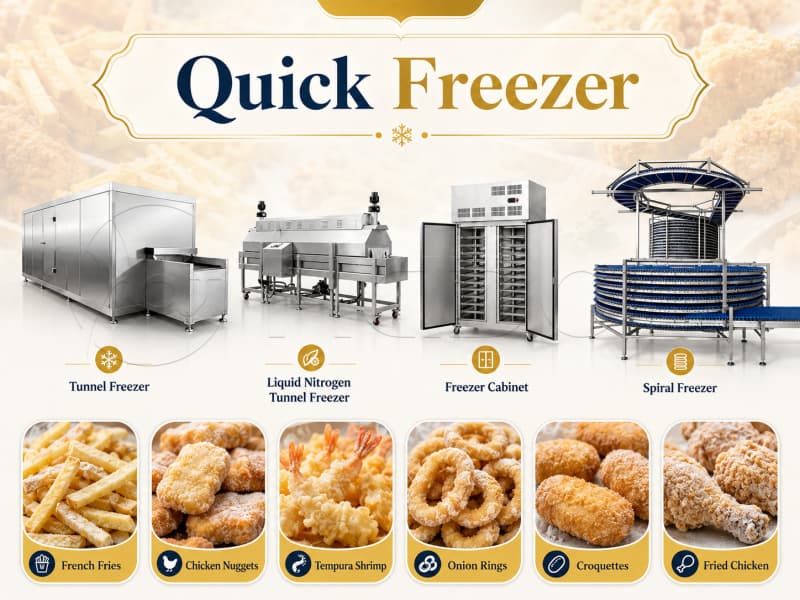
Quick Freezer
Quick Freezer

How Do Raw Materials and Coating Formulas Affect Chicken Nugget Freezing?

The raw material formula determines nugget strength throughout food preparation and freezing. Factories may process minced chicken breast, mixed chicken meat, plant-protein blends, vegetable-filled nuggets, cheese-filled products, fish nuggets, or other formed foods. Each mixture creates different moisture, fat, protein, and binding behavior. The forming machine should create consistent unit weight and thickness, while the predust, batter, and bread crumbs should form a continuous shell. Buyers can review formed and breaded chicken nugget products when they define product specifications. Moreover, the production manager should control product temperature before coating because soft formed pieces can deform and warm surfaces can weaken adhesion.

Why Must the Par-Frying Process Set the Coating Before IQF Freezing?

Par-frying should give the outer layer enough structure for downstream handling without completing the final consumer cooking step. The fryer must control oil temperature, residence time, belt speed, product spacing, and immersion depth according to nugget size and coating pickup. A continuous fryer configuration for par-fried breaded poultry can connect controlled frying with deoiling, cooling, and quick-freezing machinery. If the process delivers pale, wet, or weak coating, later conveyors may remove crumbs. If the process applies excessive heat, the product may lose more moisture and develop a rigid shell. Therefore, the factory should validate the frying procedure together with the freezing procedure.

How Should Cooling and Deoiling Protect Coating Before the Freezer?

The line should remove loose oil and reduce product temperature in a controlled sequence before IQF treatment. A vibrating deoiler or draining conveyor can remove surface oil, while a cooling conveyor can release heat and steam. The production team should avoid deep product piles because trapped heat creates uneven inlet conditions. Moreover, the conveyor should maintain a single layer and limit high drops, sharp turns, and belt-speed changes. This food handling design protects corners and edges where coating often breaks first. Controlled cooling also helps the freezer manage a narrower inlet-temperature range, which supports more consistent residence time and reduces unnecessary refrigeration load during continuous food manufacturing.

Which IQF Freezer Controls Reduce Cracking and Product Adhesion?

The freezer should match air movement, belt loading, residence time, product size, and target outlet temperature. Operators should feed nuggets in one layer with enough spacing for cold air to reach the top, bottom, and sides. A tunnel system can support straight continuous flow, while a spiral system can provide longer residence time within a compact floor area. The factory should also synchronize the freezer belt with the upstream cooler so products do not collide at the inlet. An industrial tunnel freezing system for coated chicken products should handle the required throughput without forcing excessive bed depth. Consequently, balanced food freezing technology supports coating integrity better than a high-capacity claim alone.

How Can a Complete Nugget Line Coordinate Forming, Coating, Frying, and Freezing?

A coordinated food production line can include meat preparation, mixing, forming, predusting, battering, breading, par-frying, deoiling, cooling, IQF freezing, weighing, and packaging. Each machine should deliver the same practical hourly output, and every transfer should protect product orientation and spacing. The coating equipment should limit loose crumbs before frying, while the fryer filtration system should manage coating residues. The cooler should stabilize the freezer feed, and the packaging section should avoid long exposure after freezing. Fried food solutions line engineering for coated frozen foods gives procurement teams a reference for connecting separate machinery into one food manufacturing system. This coordinated design also simplifies production management and expansion planning.

What Information Supports an Accurate IQF Equipment Quotation and Budget?

The buyer should provide the nugget recipe, dimensions, unit weight, coating type, par-frying conditions, inlet temperature, target core temperature, hourly capacity, operating hours, packaging format, refrigeration source, workshop layout, voltage, and ambient conditions. The supplier also needs the available floor area, ceiling height, cleaning plan, drainage, compressor location, and planned line expansion. These details affect freezer type, belt width, tunnel or spiral length, air circulation, refrigeration load, defrost management, and final price. A complete quotation should separate the freezer, refrigeration unit, insulated enclosure, conveyors, controls, installation conditions, freight, and optional modules. This comparison helps an investor buy cost-effective equipment within a realistic project budget.

Stable chicken nugget freezing begins before products enter the freezer. The factory should control raw material preparation, forming consistency, coating adhesion, par-frying, oil removal, cooling, single-layer feeding, air distribution, residence time, and packaging transfer as one continuous food processing procedure. Tunnel and spiral freezer designs can both support coated products when engineers match the equipment with real capacity and workshop conditions. This total-process review helps manufacturers reduce avoidable coating damage and compare machinery investment on equal terms. Customers can review the target equipment at https://www.friedfoodsolutions.com/quick-freezer/

Какое оборудование нужно птицефабрике для переработки куриного помета

Птицефабрике следует выбирать технологию не по одной машине, а по объёму свежего помёта, влажности, виду подстилки и планируемому товарному продукту. Оборудование для переработки куриного помёта на птицефабрике должно охватывать приём сырья, подготовку смеси, контролируемое компостирование и последующую переработку в порошковое или гранулированное органическое удобрение.

Chicken manure fertilizer production

Участок приёма и подготовки сырья

Сначала необходимо организовать крытую площадку или бункер, где свежий помёт не смешивается с готовым продуктом. Если сырьё слишком влажное, проект предусматривает смешивание с сухим структурным материалом или механическое обезвоживание — выбор зависит от состава и местных условий. Магнитные и механические примеси следует удалить до того, как они попадут в дробилку или смеситель.

Дозатор и смеситель помогают поддерживать повторяемый состав компостной смеси. Птицефабрике важно учитывать не только массу помёта, но и суточные колебания влажности, содержание подстилки и доступность наполнителя. Эти данные определяют производительность последующих машин.

Оборудование для компостирования

Для открытой или крытой площадки применяют самоходные и гусеничные ворошители. Для траншейного способа используют машины, работающие по ферментационным каналам. Закрытый ферментатор рассматривают, когда площадка ограничена или требуется более контролируемая обработка воздуха. При выборе площадочной схемы можно оценить самоходный ворошитель для площадочного компостирования.

Ворошитель перемешивает массу и поддерживает доступ воздуха, но качество компоста также зависит от влажности, структуры смеси, температуры и продолжительности процесса. Общие принципы приготовления зрелого компоста полезны как справочная база, а рабочий регламент следует устанавливать по анализу конкретного сырья и требованиям местного законодательства.

Линия по производству гранулированных органических удобрений

Порошковый или гранулированный продукт

Для порошкового удобрения после созревания компоста обычно нужны дробилка, грохот, накопительный бункер и упаковочная машина. Такая схема проще и требует меньше оборудования. Она подходит, если местный рынок принимает порошок и расстояние перевозки невелико.

Гранулированный продукт требует более длинной цепочки. Линия производства гранулированного удобрения из куриного помёта может включать дробление, дозирование добавок, смешивание, грануляцию, сушку, охлаждение, просеивание, возврат некондиционной фракции, нанесение покрытия и фасовку. Конкретный тип гранулятора выбирают после проверки влажности и способности подготовленного компоста формировать прочные частицы.

Вспомогательные системы, которые часто недооценивают

В проект необходимо включить конвейеры, аспирацию, сбор пыли, вентиляцию, очистку воздуха, электрошкафы, площадки обслуживания и лабораторный контроль. Также важны разделение чистых и загрязнённых зон, отвод фильтрата, мойка площадки и запас критических деталей. Требования к выбросам, обращению с отходами и регистрации удобрения нужно подтвердить по месту реализации проекта.

Чтобы получить решение под объём вашего предприятия, поставщику следует сообщить поголовье, суточный объём помёта, влажность, тип подстилки, доступную площадь, климат, желаемый продукт, упаковку и годовой режим работы. После этого можно согласовать технологическую схему, перечень машин и предварительный бюджет без необоснованных обещаний по производительности.

Для получения более подробной информации, пожалуйста, посетите: https://www.liniyaudobreniy.com/resheniye-kurinyy-pomet-kak-odobreniye/