Par-fried chicken nugget factories need a controlled transition from hot oil to frozen storage. An IQF quick freezer for par-fried chicken nuggets can support fast food freezing only when the upstream forming, coating, frying, deoiling, cooling, and conveying stages deliver stable products. Sudden transfers, uneven nugget temperature, excess surface oil, overlapping pieces, and weak coating adhesion can create cracks or crumb loss before the freezer completes its work. Therefore, a frozen food manufacturer should evaluate the whole production process rather than treating quick freezing as an isolated treatment.
How Do Raw Materials and Coating Formulas Affect Chicken Nugget Freezing?
The raw material formula determines nugget strength throughout food preparation and freezing. Factories may process minced chicken breast, mixed chicken meat, plant-protein blends, vegetable-filled nuggets, cheese-filled products, fish nuggets, or other formed foods. Each mixture creates different moisture, fat, protein, and binding behavior. The forming machine should create consistent unit weight and thickness, while the predust, batter, and bread crumbs should form a continuous shell. Buyers can review formed and breaded chicken nugget products when they define product specifications. Moreover, the production manager should control product temperature before coating because soft formed pieces can deform and warm surfaces can weaken adhesion.
Why Must the Par-Frying Process Set the Coating Before IQF Freezing?
Par-frying should give the outer layer enough structure for downstream handling without completing the final consumer cooking step. The fryer must control oil temperature, residence time, belt speed, product spacing, and immersion depth according to nugget size and coating pickup. A continuous fryer configuration for par-fried breaded poultry can connect controlled frying with deoiling, cooling, and quick-freezing machinery. If the process delivers pale, wet, or weak coating, later conveyors may remove crumbs. If the process applies excessive heat, the product may lose more moisture and develop a rigid shell. Therefore, the factory should validate the frying procedure together with the freezing procedure.
How Should Cooling and Deoiling Protect Coating Before the Freezer?
The line should remove loose oil and reduce product temperature in a controlled sequence before IQF treatment. A vibrating deoiler or draining conveyor can remove surface oil, while a cooling conveyor can release heat and steam. The production team should avoid deep product piles because trapped heat creates uneven inlet conditions. Moreover, the conveyor should maintain a single layer and limit high drops, sharp turns, and belt-speed changes. This food handling design protects corners and edges where coating often breaks first. Controlled cooling also helps the freezer manage a narrower inlet-temperature range, which supports more consistent residence time and reduces unnecessary refrigeration load during continuous food manufacturing.
Which IQF Freezer Controls Reduce Cracking and Product Adhesion?
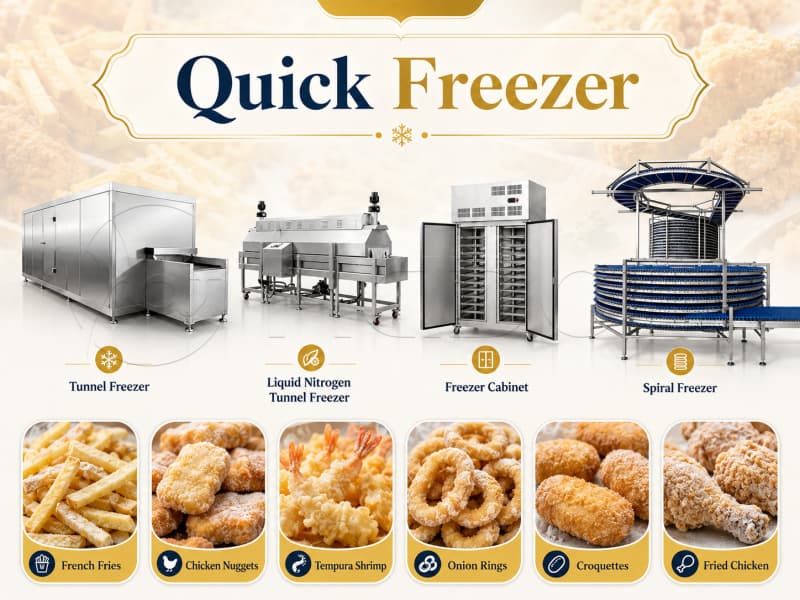
The freezer should match air movement, belt loading, residence time, product size, and target outlet temperature. Operators should feed nuggets in one layer with enough spacing for cold air to reach the top, bottom, and sides. A tunnel system can support straight continuous flow, while a spiral system can provide longer residence time within a compact floor area. The factory should also synchronize the freezer belt with the upstream cooler so products do not collide at the inlet. An industrial tunnel freezing system for coated chicken products should handle the required throughput without forcing excessive bed depth. Consequently, balanced food freezing technology supports coating integrity better than a high-capacity claim alone.
How Can a Complete Nugget Line Coordinate Forming, Coating, Frying, and Freezing?
A coordinated food production line can include meat preparation, mixing, forming, predusting, battering, breading, par-frying, deoiling, cooling, IQF freezing, weighing, and packaging. Each machine should deliver the same practical hourly output, and every transfer should protect product orientation and spacing. The coating equipment should limit loose crumbs before frying, while the fryer filtration system should manage coating residues. The cooler should stabilize the freezer feed, and the packaging section should avoid long exposure after freezing. Fried food solutions line engineering for coated frozen foods gives procurement teams a reference for connecting separate machinery into one food manufacturing system. This coordinated design also simplifies production management and expansion planning.
What Information Supports an Accurate IQF Equipment Quotation and Budget?
The buyer should provide the nugget recipe, dimensions, unit weight, coating type, par-frying conditions, inlet temperature, target core temperature, hourly capacity, operating hours, packaging format, refrigeration source, workshop layout, voltage, and ambient conditions. The supplier also needs the available floor area, ceiling height, cleaning plan, drainage, compressor location, and planned line expansion. These details affect freezer type, belt width, tunnel or spiral length, air circulation, refrigeration load, defrost management, and final price. A complete quotation should separate the freezer, refrigeration unit, insulated enclosure, conveyors, controls, installation conditions, freight, and optional modules. This comparison helps an investor buy cost-effective equipment within a realistic project budget.
Stable chicken nugget freezing begins before products enter the freezer. The factory should control raw material preparation, forming consistency, coating adhesion, par-frying, oil removal, cooling, single-layer feeding, air distribution, residence time, and packaging transfer as one continuous food processing procedure. Tunnel and spiral freezer designs can both support coated products when engineers match the equipment with real capacity and workshop conditions. This total-process review helps manufacturers reduce avoidable coating damage and compare machinery investment on equal terms. Customers can review the target equipment at https://www.friedfoodsolutions.com/quick-freezer/