When your BB fertilizer project moves toward continuous production, the mixer cannot be selected from capacity alone. Your raw granules, batching speed, formula changes and packaging rate all affect the result. A rotary drum blender for uniform BB fertilizer formulas works best when the complete line supplies and removes material at a balanced rate.
Granule Compatibility Comes Before Mixer Capacity
BB fertilizer commonly combines urea, DAP, MAP, potassium chloride and other finished granules. These are granular materials, so differences in particle size, density and moisture can influence how the blend behaves during conveying and storage.
Before selecting a mixer, compare the granule specifications of every ingredient. Similar particles move through the drum more consistently, while large differences can increase segregation after mixing. A continuous granular fertilizer blending machine cannot correct an unsuitable raw-material combination by extending mixing time alone.
Capacity Matching from Batching to Packaging
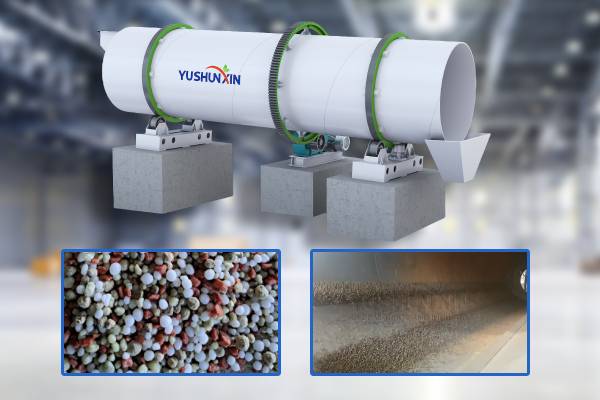
The target page lists rotary drum blender capacities from 5 to 40 TPH. Inside the rotating cylinder, lifting plates raise and release the granules repeatedly, creating a rolling and cascading flow. The slight drum inclination then moves the blend toward the outlet.
For a 30 TPH project, the batching system needs to maintain the correct ingredient ratios while the packing section handles the same finished flow. A capacity-matched rotary fertilizer blending system may include dynamic batching, belt conveying, drum mixing and twin-bucket packing.
The related 30 TPH bulk blending fertilizer plant configuration shows how a 20–40 TPH mixer can fit between automatic batching and packaging. This prevents a high-capacity blender from waiting for material or overloading the bagging section.
Carbon Steel and Stainless-Steel Options
Carbon steel can suit general fertilizer formulas, while stainless steel is available for corrosive materials, high-chlorine recipes or humid operating conditions. A stainless-steel drum mixer for commercial fertilizer plants also provides a smoother contact surface when frequent formula changes make residue control important.
Equipment material affects more than the drum body. Ask which parts contact the fertilizer and confirm the proposed material for the inlet, lifting plates, discharge section and connected conveyors.
Information Required for a Reliable Quote
Send the supplier:
- Each fertilizer ingredient and granule specification
- Required tons per hour and daily operating hours
- Number of formulas and changeover frequency
- Preferred equipment material
- Bag weight, workshop dimensions and local voltage
These details support a rotary drum mixer configuration for bulk fertilizer production based on your real process. You can learn more before requesting the equipment list and layout:
https://www.mixedfertilizermachines.com/products/rotary-drum-blender/