How Can a Double Roller Extrusion Granulator Improve Lime Powder Fertilizer Manufacturing?

In the fertilizer manufacturing industry, raw materials play a pivotal role in determining the quality and effectiveness of the final product. Lime powder, derived from limestone, serves as a crucial ingredient in producing various types of fertilizers. However, the efficacy of lime powder in fertilizer production greatly depends on its granulation process. A double roller extrusion granulator offers numerous advantages in improving the manufacturing of lime powder fertilizers. This blog discusses the specific needs for fertilizer production and how this machinery enhances the granulation process.

What Raw Materials Are Suitable for Fertilizer Production?

Lime rock is one of the primary raw materials used in fertilizer production. Its rich calcium carbonate content provides essential nutrients that enhance soil health. The agriculture sector benefits from lime rock by improving soil pH levels, promoting better crop yields, and increasing nutrient uptake. In addition to lime, other raw materials such as ammonium sulfate and potassium sulfate are commonly utilized. Ammonium sulfate serves as a nitrogen source, while potassium sulfate enhances the potassium content in fertilizers. Each of these materials caters to specific plant nutrient requirements, thus benefiting various agricultural sectors.

The combination of these raw materials requires a reliable granulation process. Without proper granulation, the effectiveness of these materials diminishes. Companies engaged in fertilizer manufacturing must ensure they utilize machinery that enhances the granulation of lime powder and other ingredients effectively.
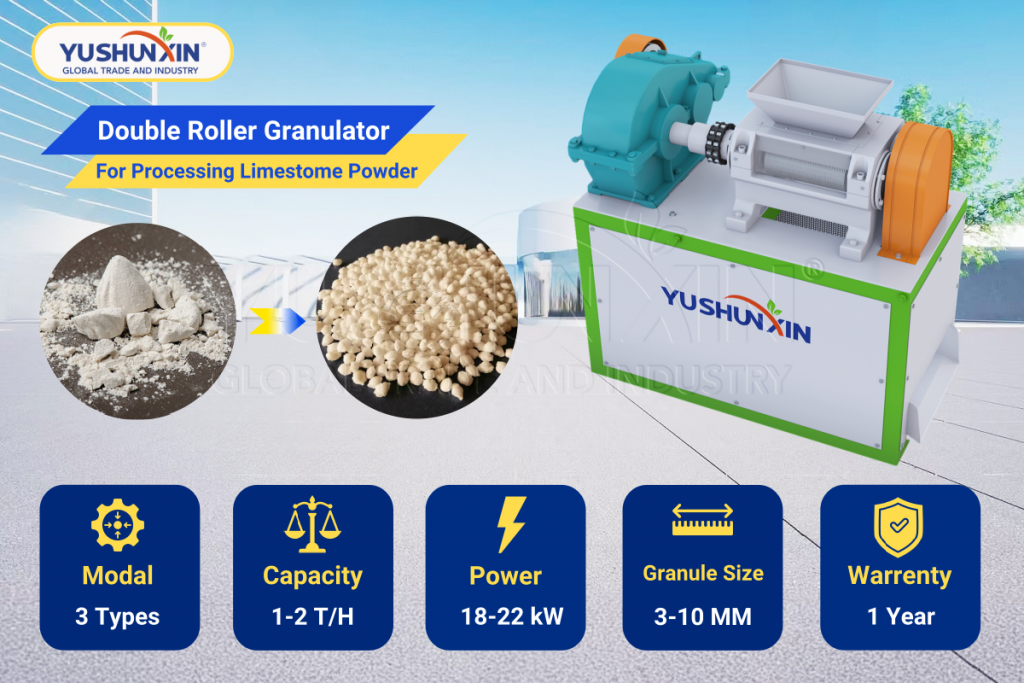
Limestone Powder Granulator

How Does a Double Roller Extrusion Granulator Enhance Lime Powder Granulation?

A double roller extrusion granulator operates on the principle of dry granulation. This machine compresses and shapes lime powder and other materials into granules without the need for liquid binders. The dry granulation process provides several advantages, including reduced energy consumption and lower operating costs.

In this procedure, the lime powder is fed into the machine through a loader type feeder. Once inside, the powder is compacted between two rollers, forming dense particles. This method ensures the production of uniform granules with a consistent size, essential for quality fertilizer manufacturing. The machine’s design minimizes dust and waste, optimizing the material utilization in the production process.

Additionally, the double roller extrusion granulator is equipped with features such as adjustable roller pressure and speed, allowing operators to customize the granulation process. This flexibility ensures that the machine can accommodate various formulations, thereby enhancing the versatility of the lime powder fertilizer production.

What Benefits Does Efficient Granulation Bring to Fertilizer Manufacturing?

Efficient granulation leads to improved flowability and handling of lime powder fertilizers. Well-shaped granules prevent clumping, ensuring smooth operation during packaging and application. This is particularly important for automatic packaging scales, which rely on the consistent flow of granules for accurate measurements and efficient processing.

Moreover, granulating lime powder enhances its solubility and nutrient availability in the soil. When applied, these granules dissolve more readily, supplying essential nutrients to plants without delay. Fertilizer manufacturers can thus achieve better customer satisfaction due to the improved performance of their products.

Integrating a double roller extrusion granulator into the lime powder fertilizer production line streamlines the manufacturing process further. The inclusion of complementary equipment, such as chain crushers, horizontal mixers, and rotary screening machines, creates a cohesive system that improves overall efficiency.

Conclusion

The manufacturing of lime powder fertilizers can significantly benefit from the use of a double roller extrusion granulator. This machine not only improves the granulation process, producing uniform and effective granules, but also enhances the overall efficiency of fertilizer production. By understanding the specific needs of raw materials and leveraging advanced machinery, fertilizer manufacturers can optimize their operations.

For businesses aiming to enhance their lime powder fertilizer manufacturing processes, investing in high-quality equipment is essential. Yushunxin, a professional fertilizer equipment manufacturer, offers a range of solutions designed to improve granulation and production efficiency, ensuring that your fertilizer meets the demands of the industry. You can visit: https://www.extruder-granulator.com/product/limestone-powder-granulation-machine/
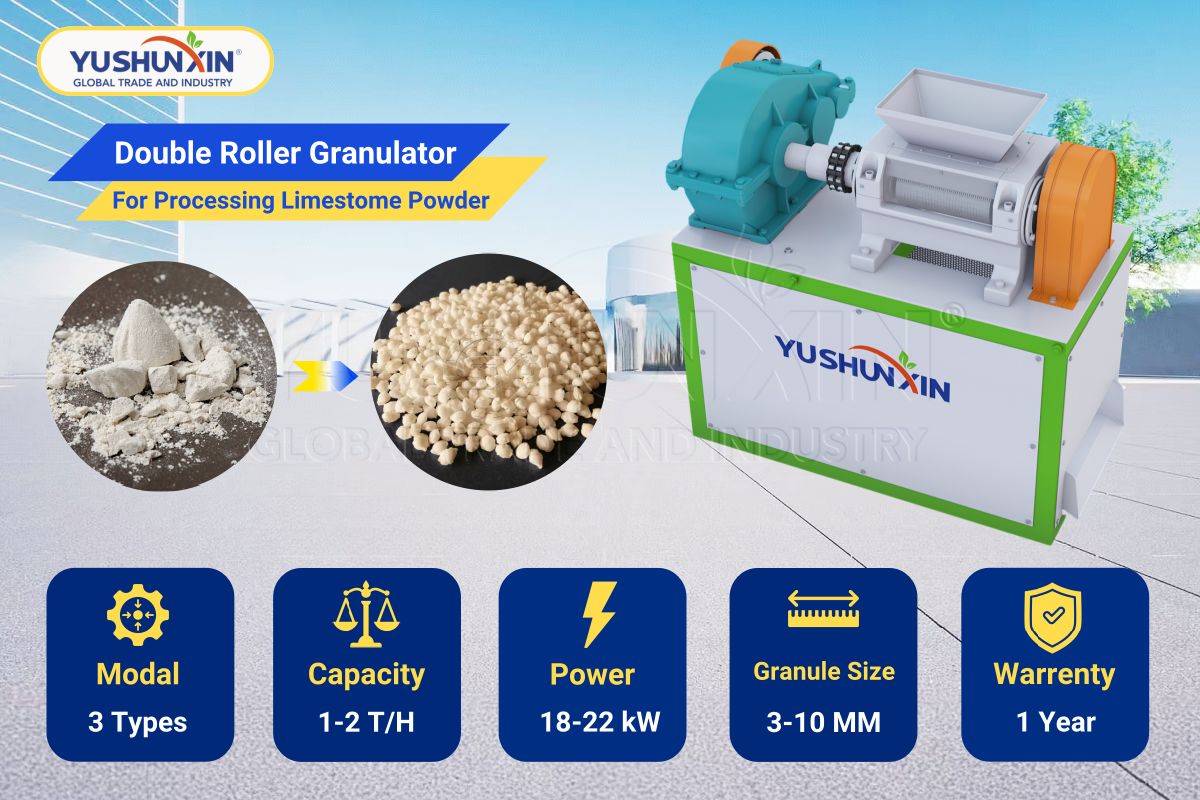
What Is the Impact of Raw Material Quality on the Granulation Process of Limestone Powder?

The quality of raw limestone powder directly determines the stability, efficiency, and cost of lime-based fertilizer granulation. When customers choose suitable lime rock materials and control particle size, moisture, and purity, the granulation line runs more smoothly, and the resulting fertilizer granules show better strength, uniformity, and application performance. In contrast, unstable raw materials create frequent problems in lime pellet making procedures, such as low balling rate, excessive dust, and high equipment wear. Therefore, every fertilizer producer needs to treat raw material selection and preparation as a core part of the entire lime fertilizer manufacturing process, not as a simple preliminary step.


1. How Do Different Raw Materials Influence Lime Fertilizer Granulation in Various Industries?

Limestone-based fertilizer production does not only serve traditional agriculture. Many industries, including soil improvement, environmental treatment, and industrial by-product utilization, rely on lime or limestone powder granulation for stable and easy-to-handle products. Each industry faces different raw material requirements and obtains different benefits from optimized granulating conditions, therefore customers need to choose suitable lime rock sources and blending materials.

In soil conditioning and pH regulation, high-calcium limestone powder with moderate fineness usually supports consistent granule formation. When the particle size distribution remains stable, the double roller extrusion granulator compacts the material into uniform pellets with reliable crushing strength. This stability allows the rotary screening machine to separate qualified particles efficiently, while undersize and oversize granules return to the chain crusher and horizontal mixer for reprocessing. As a result, the overall production line keeps a balanced circulation, and fertilizer companies gain predictable output and lower recycle rates.

In environmental protection applications, such as desulfurization residue or industrial lime mud reuse, raw materials may contain more impurities and variable moisture. Producers in this area often choose to pre-treat the lime-based material with a loader type feeder and a controlled feeding system, because steady and homogeneous feeding reduces pressure fluctuations in the extrusion section. When the moisture, impurity content, and powder fineness remain under control, the dry granulation procedure through a double roller extruder can still form compact particles, even from challenging lime residue blends. This process helps waste recycling businesses convert unstable powder streams into valuable lime fertilizer pellets for land reclamation or mine restoration projects.

For compound lime fertilizer manufacturing, many companies blend limestone or dolomitic lime powder with nitrogen, phosphorus, and potassium sources. In this case, raw material compatibility and mixing uniformity become critical. The horizontal mixer needs consistent material behavior to create a homogenous preparation before the powder enters the pelletizer or double roller press. When the raw limestone features suitable fineness and low moisture, the granulation section produces high-density granules with well-distributed nutrients. Customers then obtain balanced NPK fertilizer products that improve crop nutrition management, although the core focus remains on granule formation performance rather than direct agricultural effects.

Limestone Powder Granulator

2. Why Does Raw Limestone Powder Quality Matter So Much for Granulation Efficiency and Product Performance?

The granulation process of lime-based fertilizer involves multiple tightly linked steps, including material feeding, crushing, mixing, compacting, shaping, screening, and packaging. Every step reacts to the physical and chemical properties of limestone powder. When raw materials meet stable quality standards, the entire production line reaches higher output and lower operating cost. Therefore, fertilizer plants regard raw material quality not as a theoretical concept but as a direct factor influencing profit and product reputation.

Particle size distribution of limestone powder strongly affects the granulating behavior. Very fine powder improves surface contact during double roller extrusion, so the compacted sheets or ribbons break into granules with good strength. However, excessively fine lime powder often increases dust load, causes poor flow in hoppers, and raises binder consumption. On the other hand, coarse lime rock particles may create voids inside granules, reduce density, and lead to easy breakage during rotary screening and belt conveyor transport. Consequently, many producers aim for a balanced limestone fineness range that matches the specific granulator, whether it is a dry compaction pelletizer, a ball making disc, or another type of granulation machine.

Moisture content also plays a crucial role. In dry granulation with a double roller extrusion granulator, lower and stable moisture allows the powder to compact effectively under pressure. If moisture fluctuates, the extruder may produce inconsistent sheets, leading to variable granule size and unsteady load on the rotary screening machine. In some lime fertilizer pelletizing lines, controlled moisture addition before mixing can enhance inter-particle bonding, but excessive water causes sticking problems inside the mixer, the press roll, and the screening equipment. Therefore, a stable moisture range helps customers maintain efficient operation and avoid unplanned cleaning and downtime.

Chemical composition and impurity levels significantly influence granule performance as well. High-purity limestone with predictable CaCO₃ content ensures consistent neutralizing value in the finished fertilizer particles. When producers apply such material, they can standardize granule size and nutrient content, so the automatic packaging scale fills bags with reliable product quality. If the raw lime rock contains clay, sand, or variable magnesium content, the granulation line may face problems such as roller surface wear, screen clogging, or uneven mechanical strength of pellets. High-quality raw materials therefore extend the lifetime of key machinery, including the double roller press, chain crusher, and belt conveyors, and reduce maintenance costs.

In addition, the choice of auxiliary materials and blending ratios interacts with limestone quality. Many fertilizer manufacturers combine lime powder with organic matter, micro-nutrients, or industrial by-products. When the base limestone powder remains uniform and stable, the horizontal mixer can form a consistent composite feed for subsequent granulation. The pellet making or compacting equipment then produces multi-component granules that still keep good shape, flowability, and storage stability. Customers who invest in careful raw material evaluation generally achieve stronger pellets, lower breakage in handling, and better market acceptance of their lime-based fertilizer products.


Conclusion

A complete limestone fertilizer granulation line usually integrates multiple units, such as a loader type feeder for stable supply, a chain crusher for size reduction, a horizontal mixer for homogenization, a double roller extrusion granulator for dry compacting, a rotary screening machine for particle size classification, belt conveyors for material transfer, and an automatic packaging scale for accurate bagging. When customers match suitable raw material quality with properly configured equipment, the lime fertilizer production process becomes more predictable, economical, and scalable.

For companies that plan to optimize lime rock powder granulation or upgrade existing production lines, cooperation with a professional fertilizer equipment manufacturer helps align raw material characteristics with suitable machinery selection and process design. A professional fertilizer equipment manufacturer – Yushunxin – offers support for limestone powder preparation, double roller dry granulation system configuration, and integrated lime fertilizer manufacturing solutions to help producers achieve stable, high-quality pellet output. You can visit: https://www.extruder-granulator.com/product/limestone-powder-granulation-machine/

What Factors Influence the Efficiency of Extrusion Granulation in Lime Powder Processing?

In modern fertilizer engineering, extrusion granulation plays a decisive role in improving product quality and optimizing production efficiency. When industries use lime powder or limestone materials to prepare compound fertilizers, several interrelated factors determine the performance of the granulating process. The following discussion explores these influential elements from raw material selection to equipment configuration, leading to a professional understanding of lime-based fertilizer granule manufacturing.


1. What Types of Raw Materials Affect the Performance of Lime Powder Fertilizer Granulation?

The efficiency of extrusion granulation depends largely on the chemical and physical nature of raw materials. Lime powder, limestone, and lime rock with moderate fineness and balanced moisture content provide better compacting and forming properties. When used as a calcium supplement in fertilizer manufacturing, they help neutralize soil acidity, promote nutrient absorption, and enhance particle hardness. The construction material industry often prefers finely milled lime powder for consistent granule strength, while the environmental sector benefits from using lime rock granules for wastewater treatment adsorbents.

When combining lime-based materials with additional mineral sources such as phosphate rock or magnesium oxide, the granulation process achieves a more uniform mix, which directly affects extrusion pressure and granule uniformity. Therefore, the choice and proportion of each material significantly influence the energy consumption, extrusion force, and granule durability. Balanced material composition ensures that the final lime fertilizer particles maintain stable physical structure during storage and transportation.

Limestone Powder Granulator

2. How Do Machine Configurations and Granulating Techniques Improve Lime Fertilizer Production Efficiency?

In lime powder fertilizer preparation, machinery selection determines the consistency and efficiency of granulation. A loader-type feeder supplies raw materials evenly, ensuring continuous feed during production. A crane crusher refines large limestone lumps into smaller, easily mixable particles. The horizontal mixer then blends lime powder with other additives, forming a uniform base for extrusion.

The double roller extrusion granulator serves as the core of the system. This equipment compacts dry materials under high pressure, forming dense granules without the need for additional moisture or heat. Such dry granulation or compacting procedure reduces drying time and energy consumption while improving product uniformity. After extrusion, the rotary screening machine separates qualified pellets from oversized or undersized ones. Belt conveyors transfer the sorted materials to the automatic packaging scale, completing an efficient and automated fertilizer production line.

These interconnected machines maintain stable operation and precise control of particle size distribution. By adjusting roller gap, pressure, and feeding speed, operators can optimize granule density and surface smoothness. Consequently, industries processing lime powder fertilizers achieve higher mechanical strength and reduced dust generation during handling.


3. Why Do Operating Parameters and Production Environment Determine the Stability of Lime Granulation?

Stable granulating performance requires balanced operational conditions. Extrusion pressure, roller temperature, and feed rate must match the physical characteristics of lime powder. If the pressure is too low, granules may remain loose; if too high, they may crack. Controlled humidity prevents agglomeration while allowing smooth particle release from the press rollers.

Moreover, the cleanliness of the production environment influences mechanical wear and product quality. Dust accumulation around the extruder or pelletizer can cause uneven feeding and equipment abrasion. Regular maintenance of the granulation machinery ensures consistent compacting performance, extending service life and reducing downtime. For large-scale lime powder fertilizer manufacturing, automated control systems enable accurate parameter adjustment, further improving efficiency and reducing labor intensity.


4. Comprehensive Understanding and Industrial Implications

Extrusion granulation in lime powder fertilizer production represents a delicate balance between raw material properties, mechanical design, and operational management. Proper coordination among these aspects ensures high-efficiency particle formation, stable product size, and reduced environmental impact. Industries that process limestone-based fertilizers can enhance competitiveness through continuous improvement of their granulating process, adopting advanced equipment and optimized technology to achieve consistent quality.

A professional fertilizer equipment manufacturer—Yushunxin—provides integrated solutions for lime powder granulation, from raw material feeding to automatic packaging. The company’s expertise in double roller extrusion systems and supporting machinery helps industrial users build efficient, durable, and sustainable fertilizer production lines tailored to diverse material requirements and process goals. You can visit: https://www.extruder-granulator.com/product/limestone-powder-granulation-machine/

What Are the Cost Implications of Different Granulating Methods for Lime Powder?

The production of lime-based fertilizer granules involves several technical procedures and machinery choices, and each method of granulation leads to distinct cost implications. Different industries such as agriculture, chemical processing, and environmental management demand lime powder or limestone-based particles in specific forms. Therefore, understanding the raw materials, their industrial needs, and the equipment required for granule manufacturing becomes essential for evaluating production costs.


Which Raw Materials Suit Lime Fertilizer Granulation and What Benefits Do They Provide?

Lime rock, limestone powder, and hydrated lime represent the most common bases for fertilizer granule preparation. Limestone powder suits chemical and construction industries because it provides uniform granule structure and stable particle size. Hydrated lime often benefits environmental treatment companies because the granules absorb contaminants and neutralize acidity effectively. Quicklime can also be processed into pellets for metallurgical or flue gas desulfurization applications.

Each raw material requires distinct handling in the production line. For example, limestone powder demands stable feeding and precise mixing to avoid uneven granules, while hydrated lime requires dust suppression equipment to control air quality in the plant. When each industry evaluates cost implications, the type of lime powder directly affects machine configuration, energy consumption, and overall granule quality.

Limestone Powder Granulator

How Do Different Granulating Machines Influence Production Costs?

Fertilizer granulation machinery determines not only the particle size but also the overall cost efficiency of the production process. When a company selects a double roller extrusion granulator, the dry granulation method reduces energy consumption because the procedure does not require additional dryers. The extrusion press compacts lime particles into uniform pellets, which lowers operational expenses in comparison with wet pelletizing methods.

On the other hand, a pelletizer or ball-making drum machine produces round granules with higher uniformity, but the wet granulation process demands extra drying equipment, additional heating costs, and more maintenance. A horizontal mixer becomes necessary before either method to ensure even blending of the lime powder with additives. Meanwhile, a rotary screening machine plays a role in separating qualified granules from dust or oversized particles, which adds to quality control costs but reduces waste.

The choice of equipment like loader type feeder, crane crusher, and belt conveyors also impacts investment budgets. A loader feeder reduces manual labor, while a crusher prepares raw limestone for more effective mixing, and conveyors minimize transport costs inside the plant. Therefore, cost calculations must balance initial machinery investment with long-term energy, labor, and maintenance savings.


What Are the Comparative Advantages of Dry Extrusion Granulation Versus Wet Pelletizing?

The dry double roller extrusion granulation method provides significant cost advantages because it eliminates the need for high-temperature drying and complex slurry preparation. Companies that use this compact extrusion procedure often reduce energy bills and shorten the granule production cycle. This method suits lime powder granulation for fertilizer plants and for industries that demand hard, dust-free particles without additional processing.

Wet pelletizing through a rotary drum or disc pelletizer creates rounder particles that offer better spreading performance in agricultural fields and uniform dissolution rates in chemical applications. However, this process requires higher water usage, long drying time, and additional fuel for rotary dryers, which increases operational costs. Companies must weigh whether the premium quality of pellets justifies these additional expenses. The difference in total cost depends on production scale, raw material choice, and expected end-use performance.


Conclusion

In summary, lime powder, limestone, lime rock, and hydrated lime provide diverse raw materials for fertilizer pellet or particle production. Each industry must consider both benefits and limitations of these materials, as well as the machinery that shapes the granulation method. Dry extrusion granulation with a double roller extruder leads to energy savings and compact pellet production, while wet pelletizing offers better granule uniformity but at higher drying and fuel costs. Supporting equipment such as mixers, crushers, screening machines, and packaging scales further influences total investment and operational budgets.

Therefore, businesses that evaluate cost implications must align raw material characteristics, machine features, and industry-specific requirements. A professional fertilizer equipment manufacturer, Yushunxin, offers comprehensive machinery solutions that help industries make balanced decisions regarding lime powder granulation, ensuring both technical efficiency and economic sustainability. You can visit: https://www.extruder-granulator.com/product/limestone-powder-granulation-machine/

What Equipment Enhancements Can Increase Efficiency in Lime Rock Granulation?

In modern fertilizer production, raw materials like lime rock play a prominent role, particularly when manufacturers focus on enhancing efficiency during the granulation process. Optimizing this procedure not only improves product quality but also meets the particular needs of various industries that rely on lime-based fertilizers. The right equipment and process upgrades ensure that every step, from raw material preparation to final packaging, functions efficiently and reliably.


Which Raw Materials Can You Select for Efficient Lime Rock Fertilizer Granulation?

Selecting high-quality raw materials forms the foundation of efficient lime rock fertilizer pelletizing. Commonly, lime rock, limestone, quicklime, and hydrated lime serve as primary calcium sources in fertilizer making. In the steel industry, lime rock-based granules neutralize acidic by-products, while in the chemical sector, these particles regulate pH levels during chemical reactions. Wastewater treatment plants prefer lime powder granules for their ability to precipitate impurities and stabilize sludge. Additionally, construction and mining operations often use lime granules to improve soil structure and reduce environmental impact.

Each industry demands specific physical and chemical properties from lime granules. For instance, the fertilizer sector seeks uniform particle size and optimal hardness to ensure even application and slow nutrient release. Meanwhile, the chemical industry focuses on reactivity and purity, requiring precise granulation processes to achieve desired results. By understanding these differences, you can tailor raw material selection and processing steps according to your target application, thus maximizing both efficiency and product suitability.

Limestone Powder Granulator

How Do Advanced Machines Optimize the Lime Rock Fertilizer Granulation Process?

Modernization of lime stone fertilizer granule production depends heavily on the adoption of specialized equipment. The loader type feeder automates raw material input, enabling consistent feed rates and reducing labor costs. Lime rock must undergo size reduction, and a crain crusher efficiently crushes raw lumps into manageable powder, thus facilitating downstream processing. Uniform mixing, achieved with a horizontal mixer, guarantees that lime powder blends evenly with additives, which is crucial for stable pellet formation during subsequent steps.

The core of any lime rock granule manufacturing line is the double roller extrusion granulator. This dry granulation machine compacts and presses powders between rollers to create dense, uniform particles without the need for drying. As a result, extrusion granulation minimizes energy consumption and shortens production cycles. Once formed, rotary screening machines separate qualified pellets from fines and oversized particles, ensuring consistent granule quality. Belt conveyors interconnect these processes, streamlining material flow and reducing manual handling. Finally, automatic packaging scales deliver precise filling and sealing, preparing the finished product for safe storage and transportation.


What Machine Features Contribute to Increased Output and Product Consistency in Lime Rock Granulation?

Efficiency improvements in lime rock fertilizer pelletizing machinery frequently hinge on specific advanced features. The loader type feeder offers variable speed controls, allowing operators to match feed rates with downstream capacity, thus preventing blockages or shortages. Crain crushers with adjustable screens can produce various powder finenesses, catering to distinct pellet size requirements across industries. Horizontal mixers with high-shear paddles ensure thorough blending, eliminating the risk of ingredient segregation in the final pellet.

Double roller extrusion granulators provide interchangeable roller molds, enabling production of diverse pellet shapes and sizes to meet customer demands. This adaptability particularly benefits markets that require specialty lime stone fertilizer particles for targeted applications. Rotary screening machines with multi-layer screens efficiently classify granules, increasing overall yield by recycling out-of-spec material back into the process. Advanced belt conveyors equipped with dust suppression systems maintain a clean environment, while automatic packaging scales equipped with precision sensors guarantee exact product weights, enhancing customer satisfaction.


Conclusion

Efficient lime rock fertilizer granulation requires a holistic approach that combines careful raw material selection with the integration of advanced machinery. By investing in purpose-built equipment such as feeders, crushers, mixers, double roller extrusion pelletizers, screeners, conveyors, and packing scales, manufacturers can achieve superior output, consistent particle quality, and reduced operational costs across diverse industries. For those seeking reliable solutions, a professional fertilizer equipment manufacturer like Yushunxin stands ready to provide tailored lime rock fertilizer granule production lines that meet evolving market demands. You can visit: https://www.extruder-granulator.com/product/limestone-powder-granulation-machine/

How Does a Granulator Machine Transform Limestone Powder into Fertilizer Pellets?

Fertilizer granulation technology reshapes how industries convert essential raw materials into valuable products. Among these, lime rock and limestone powder play critical roles in producing high-quality fertilizer pellets. Understanding the transformation process and the machinery involved is key for businesses aiming to optimize their fertilizer pellet production line. This blog explores which raw materials best suit fertilizer manufacturing, the benefits for different sectors, and how advanced lime powder granulator equipment, such as double roller extrusion technology, handles the granulation of limestone-based powders.


Which Raw Materials Suit Fertilizer Pellet Manufacturing Across Industries?

Various industries select raw materials based on specific fertilizer product goals. For the chemical industry, processed limestone powder offers excellent neutralizing capacity, making it ideal for manufacturing compound fertilizer granules. Metallurgical sectors benefit from lime powder’s fluxing properties, using it to prepare granulated additives that enhance smelting procedures. In environmental management, crushed lime rock functions as a pH adjuster; granulating it into limestone pellets ensures safer and more precise application in soil remediation projects.

Additionally, construction materials suppliers use hydrated lime during dry granule production for soil stabilization. Each material—crushed limestone, quicklime, hydrated lime, and dolomite—provides unique physical or chemical properties. By choosing the right powder for granulation, businesses ensure the resulting fertilizer pellets meet end-user expectations in consistency, size, and nutrient profile. The diversity of raw materials enables the fertilizer industry to tailor pellet manufacturing to various market segments, including horticulture, landscaping, and environmental restoration.

Limestone Powder Granulator

What Features Does Granulation Machinery Offer for Lime Fertilizer Production?

Modern granulation machines boast technological advancements to ensure efficient, high-yield pellet production. Loader type feeders transport limestone powder or lime rock into the production line, delivering a consistent feed rate. Crain crushers reduce large chunks into fine particles, ready for uniform mixing. The horizontal mixer then combines lime powder with binders or other nutrient additives to create a homogenous mixture vital for stable granulation.

The double roller extrusion granulator stands out as a key piece of equipment in pellet making. This extruder employs a dry granulation process, compacting the powder between two rollers to form dense fertilizer granules without requiring additional moisture or heat. The procedure not only conserves energy but also maintains the natural properties of lime-based powders. Rotary screening machines classify the finished pellets by size, ensuring that only uniform particles proceed to automatic packaging scales for bagging and shipment. Belt conveyors integrate each stage, streamlining the production process and minimizing material loss along the way.


How Does the Granulation Process Transform Limestone Powder into Uniform Fertilizer Pellets?

The granulation or pelletizing process begins when the loader type feeder introduces limestone powder into the production line. The procedure starts with size reduction using a crain crusher, followed by intensive blending in the horizontal mixer. Uniform mixing is crucial for ensuring consistent pellet quality. During the double roller extrusion phase, the machinery compresses the blended powder into compact pellets, leveraging mechanical pressure rather than high-temperature techniques. This method, known as dry granulation or roller compaction, is particularly suitable for moisture-sensitive lime-based materials.

Afterward, the rotary screening machine separates granules by diameter, allowing only those that meet production specifications to advance. Subpar particles may be reprocessed, ensuring minimal waste and maximum yield. The automatic packaging scale then weighs and bags the finished lime fertilizer pellets, ready for storage or commercial distribution. Throughout this pellet manufacturing sequence, each machine contributes to a seamless transformation from raw lime powder to high-value, easily applied fertilizer granules.


Why Should Businesses Invest in Advanced Lime Fertilizer Granulation Equipment?

Investing in modern granulator and pelletizer technology delivers significant advantages for fertilizer manufacturers. Efficient double roller extrusion granulators reduce operational costs through energy savings and low maintenance requirements. Consistent pellet quality enhances user satisfaction and simplifies downstream application in environmental, construction, and industrial projects. Integrating loader type feeders, horizontal mixers, rotary screening machines, and automated packaging systems further streamlines the lime fertilizer production process, supporting scalability and flexibility in changing markets.


Conclusion

Manufacturers across industries rely on sophisticated granulation equipment to convert limestone powder, lime rock, and related materials into uniform, market-ready fertilizer granules. By selecting a professional fertilizer equipment manufacturer like Yushunxin, companies gain access to advanced technology and expert support, ensuring superior pellet quality and optimized production efficiency. Whether producing lime powder fertilizer pellets for soil stabilization, environmental remediation, or industrial applications, innovative granulator machines guarantee a competitive edge in the growing fertilizer market. You can visit: https://www.extruder-granulator.com/product/limestone-powder-granulation-machine/

How Does a Double Roller Extrusion Granulator Enhance Lime Powder Fertilizer Production?

Lime powder fertilizer plays a crucial role in agriculture by improving soil quality and crop yields. The production of this fertilizer involves transforming raw lime materials into granules that are easy to handle, transport, and apply. The efficiency and quality of the granulation process significantly impact the overall effectiveness of the fertilizer. Understanding how a double roller extrusion granulator enhances lime powder fertilizer production is essential for manufacturers seeking to optimize their processes.

What Raw Materials Are Suitable for Fertilizer Production?

Various raw materials are suitable for fertilizer manufacturing, each catering to specific industry needs. Lime powder, derived from limestone or lime rock, is a primary ingredient in many fertilizers due to its soil neutralizing properties. Gypsum, phosphate rock, and potassium chloride are other examples that provide essential nutrients to plants. Industries such as agriculture and horticulture benefit from these materials because they address soil deficiencies and promote healthy plant growth. Selecting the appropriate raw materials ensures that the fertilizer produced meets the nutritional requirements of different crops and soil types.

Limestone Powder Granulator

How Does a Double Roller Extrusion Granulator Enhance Lime Powder Fertilizer Production?

A double roller extrusion granulator significantly improves the production process of lime powder fertilizer by compacting the powder into uniform granules without the need for additional drying. This machine utilizes a dry granulation method where materials are forced between two rollers, forming particles through high-pressure extrusion. The granulator’s design allows for precise control over granule size and density, resulting in consistent pellet quality. By eliminating the drying phase, the equipment reduces energy consumption and operational costs. The enhanced efficiency and output provided by the double roller extrusion granulator make it an indispensable tool in fertilizer manufacturing.

Granulator for Limestone Powder

What Are the Advantages of Using a Double Roller Extrusion Pelletizer in Lime Fertilizer Manufacturing?

Using a double roller press pelletizer offers several benefits in the production of lime powder fertilizer. First, it ensures a high degree of automation, which increases production capacity while reducing labor costs. Second, the pelletizer produces granules with high strength and uniform size, improving the fertilizer’s effectiveness and ease of application. Third, the dry granulation process is environmentally friendly, as it minimizes emissions and waste. Additionally, the machine’s versatility allows it to process various raw materials, making it suitable for manufacturers producing different types of fertilizers. These advantages contribute to a more efficient and sustainable fertilizer production process.

Conclusion

Incorporating a double roller extrusion granulator into lime powder fertilizer manufacturing enhances the granulation process by improving efficiency, product quality, and sustainability. The ability to process various raw materials and produce uniform granules makes this equipment valuable for meeting the specific needs of different industries. Manufacturers aiming to optimize their fertilizer production procedures can benefit from the advanced features of this machinery. For those seeking reliable equipment, a professional fertilizer equipment manufacturer like Yushunxin offers quality solutions tailored to industry requirements. You can visit: https://www.extruder-granulator.com/limestone-powder-granulation-machine/

How to use rotary drum grannulation equipment to make limestone powder into pellets

Rotary drum granulation equipment is a widely used machine in the production of limestone powder pellets. This equipment is designed to turn fine limestone powder into uniformly sized pellets that can be used in various industrial applications. In this passage, we will discuss how to use rotary drum granulation equipment to make limestone powder into pellets.

limestone pellets granulating production plant

Understanding the Components of Rotary Drum Granulation Equipment

Before we dive into the process of using rotary drum granulation equipment, let’s first understand its components. The equipment consists of a rotating drum, a feeding system, a granulating system, a screening system, and a discharge system. The rotating drum is the main component of the equipment, where the granulation process takes place. The feeding system is responsible for feeding the limestone powder into the drum, while the granulating system helps in the formation of pellets. The screening system separates the pellets from the fine powder, and the discharge system is used to collect the pellets.

Preparing the Limestone Powder

The first step in using rotary drum granulation equipment is to prepare the limestone powder. The powder should be of uniform size and free from any impurities. It is essential to ensure that the moisture content of the powder is within the recommended range, as this will affect the quality of the pellets. If the moisture content is too low, the pellets may not form properly, and if it is too high, the pellets may become too soft and break apart.

Feeding the Powder into the Equipment

Once the limestone powder is prepared, it is time to feed it into the rotary drum granulation machine. The feeding system should be adjusted to ensure that the powder is fed into the drum at a consistent rate. This will help in the formation of uniform pellets. It is important to avoid overloading the drum, as this can result in the formation of large clumps of powder that will not form into pellets.

Granulating the Powder

As the powder enters the rotating drum, the granulating system will begin to work. The drum rotates at a specific speed, and the powder is lifted and dropped by the internal flights. This process helps in the formation of pellets. The drum’s rotation speed and the angle of the flights can be adjusted to control the size and shape of the pellets.

Screening and Collecting the Pellets

Once the pellets have formed, they will be separated from the fine powder by the screening system. The pellets will be collected in the discharge system, while the fine powder can be recycled back into the feeding system for another round of granulation. The pellets can then be dried and cooled before being used in various industrial applications.

In conclusion, rotary drum granulation equipment is an efficient and effective way to turn limestone powder into pellets. By following the steps outlined above, you can ensure that the equipment is used correctly and that the pellets produced are of high quality. Remember to always follow the manufacturer’s instructions and guidelines to achieve the best results.

How to use double roller pelletizer to make 10 t/h limestone pellets

Introduction to Double Roller Pelletizer

The roller pelletizer is a machine used to produce pellets from various materials, including limestone. It is an efficient and cost-effective way to create high-quality pellets for various applications. The double roller pelletizer works by pressing the material through two rollers that rotate in opposite directions, creating pressure and heat that forms the pellets.

Preparing Limestone for Pelletizing

Before using the double roller pelletizer to make limestone pellets, it is important to prepare the material properly. This involves crushing the limestone to a fine powder and ensuring that it is free from any impurities. The limestone should also be dried to remove any moisture, as this can affect the quality of the pellets.

Setting Up the Double Roller Pelletizer

Once the limestone is prepared, the next step is to set up the double roller pelletizer. This involves adjusting the rollers to the correct size and shape for the desired pellet size. The rollers should be set to a pressure that is high enough to create a strong pellet, but not so high that it causes the material to crumble.

Using the Double Roller Pelletizer

To use the double roller pelletizer, the prepared limestone is fed into the machine at a steady rate. The rollers press the material together, creating heat and pressure that forms the pellets. The pellets are then ejected from the machine and can be cooled and collected for use.

Achieving 10 t/h Production Rate

To achieve a production rate of 10 t/h with the double roller pelletizer, it is important to optimize the machine’s settings and ensure a consistent feed rate. This may involve adjusting the speed of the rollers, the pressure, and the size of the pellets. It is also important to regularly maintain the machine to ensure it is running at peak efficiency.

Conclusion

The double roller pelletizer is an effective and efficient way to produce limestone pellets. By properly preparing the material, setting up the machine, and optimizing its settings, it is possible to achieve a production rate of 10 t/h. With regular maintenance and careful operation, the double roller pelletizer can produce high-quality pellets for various applications.

How to make limestone powder pellets?

In the realm of industrial manufacturing, the conversion of limestone powder into granules plays a crucial role. This process not only facilitates easier management and application of the material but also enhances its practicality across multiple industries. The present article delves into the techniques and equipment employed in this transformation, providing comprehensive insights for individuals seeking to establish an efficient production line.

Understanding the Composition and Initial Steps

To embark on the granulation process, it is imperative to comprehend the nature of limestone – the prime component. Majorly consisting of calcium carbonate (CaCO3), limestone necessitates certain preparatory measures. The initial step involves grinding limestone into a fine powder, preparing it for the subsequent granulation phase. Additional preparatory tasks may encompass adjusting moisture content and eliminating impurities to ensure the production of high-quality granulation material.

NPK Materials for Double Roller Extruder

The utilization of advanced machinery lies at the core of converting limestone powder into granular form. A pivotal apparatus in this process is the double roller extrusion granulator, which adopts a dry granulation method, thereby eliminating the need for binders. This device applies pressure to the limestone powder, transforming it into uniformly shaped granules. The significance of this machine cannot be overstated as it greatly enhances process efficiency and guarantees the production of granules with consistent sizes and shapes, which are vital for their ultimate applications.

Enhancing Production Line Efficiency: Incorporating a Horizontal Mixer and Vertical Crusher

In the pursuit of premium-quality limestone granules, integrating a horizontal mixer and a vertical crusher into the production line is imperative. The horizontal mixer ensures thorough blending of limestone powder before granulation, thereby ensuring uniformity in the final product. Simultaneously, the vertical crusher proves invaluable in reducing particle size and achieving consistency in the raw material. Together, these machines optimize the production process, significantly elevating efficiency and the quality of output in the granulation line.

Double Roller Granular NPK Fertilizer Production Line

For more detailed information on a simplified NPK fertilizer granulation line, please click here.

Enhancing Production Line Efficiency: The Significance of Equipment Selection

The selection of appropriate machinery is pivotal in establishing an optimal production line for limestone granules. Equipment such as double roller extrusion granulators, horizontal mixers, and vertical crushers should be chosen based on their performance, durability, and compatibility with limestone processing requirements. Additionally, considerations should be given to equipment scalability and flexibility to cater to potential future expansion needs and variability in production demands.

Conclusion

The journey from limestone powder to granules necessitates meticulous planning, a profound understanding of material properties, and the strategic utilization of specialized machinery. By prioritizing the selection of high-performance equipment and adhering to best practices in material preparation and process execution, one can establish a robust production line. In this context, Yushunxin emerges as a professional manufacturer of fertilizer equipment, offering solutions tailored to the intricate needs of limestone granulation. Their expertise and product offerings represent a valuable asset for those aspiring to excel in the production of limestone granules. For more information, please visit: https://www.extruder-granulator.com/limestone-powder-granulation-machine/