Freeze-Dried Soup and Ready Meal Ingredients: A Production Line Guide

Instant soups, ready meals, and convenience foods all depend on ingredients that are light, stable, and fast to rehydrate. Freeze-dried vegetables and other ingredients deliver exactly that. They keep their shape, color, and nutrients, rehydrate in minutes, and can be stored at ambient temperature for years. For food factories supplying the ready-meal and soup market, a dedicated freeze-drying line is a way to add value to fresh produce and build a reliable ingredient business.

Why Freeze-Dried Ingredients

Conventional drying can shrink vegetables, darken their color, and drive off aroma. Freeze drying removes water at low temperature, so the product keeps its original structure and much of its nutritional value. When the ingredient is added to a soup or ready meal, it rehydrates quickly and closely resembles the fresh material. Because the finished product is very light, shipping and storage costs drop sharply, which matters for both domestic distribution and export.
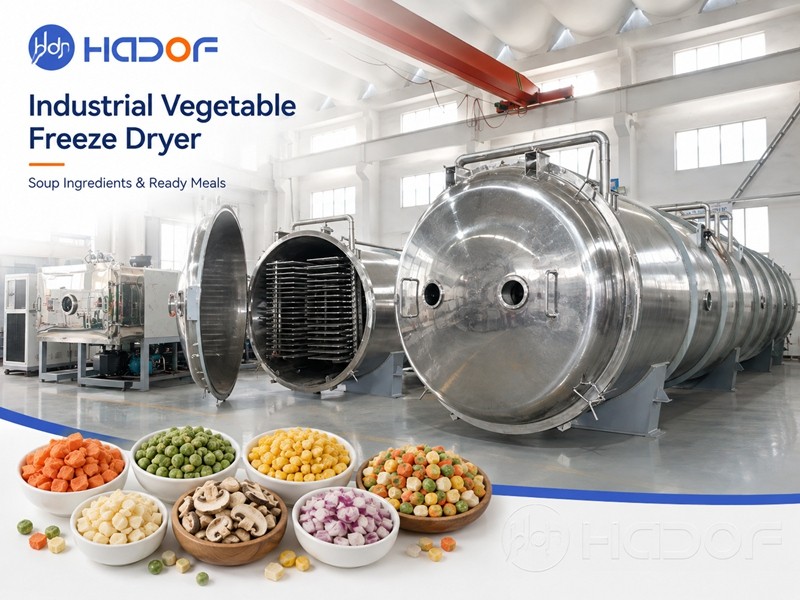
Industrial Vegetable Freeze Dryer for Soup Ingredients & Ready Meals

Industrial Vegetable Freeze Dryer for Soup Ingredients & Ready Meals

The Production Process

A freeze-dried soup and ready-meal ingredient line usually follows this sequence:

  1. Receiving and washing — fresh vegetables are inspected and washed.
  2. Cutting and size reduction — product is sliced or diced to a uniform size.
  3. Blanching — a short heat step stabilizes color and enzymes.
  4. Pre-freezing — the product is frozen quickly to protect texture.
  5. Vacuum freeze drying — ice sublimates directly to vapor at low temperature.
  6. Sorting and packaging — dried ingredients are checked and packed in barrier packaging.

Each step affects the next. Uneven cutting leads to uneven drying, and poor blanching can leave the product with off-colors or poor rehydration.

Equipment for the Line

The core of the line is the industrial vegetable freeze dryer, sized around the batch weight and shelf area your product needs. Around it, the line needs washing equipment, cutting and dicing machinery, a blanching machine, a pre-freezer, and a packing machine. For factories that also process fruit, the same line can often handle both categories with recipe and tray changes.

Pre-processing deserves attention. A bubble washer, brush roller cleaner, or vibrating dewatering machine improves product quality and reduces water load before drying. Cutting equipment should produce a consistent size so that every piece dries at the same rate. A blanching machine stabilizes color and texture before freezing.

Capacity and Configuration

Capacity is usually specified by batch weight or shelf area. Producers often start with a batch size that matches their fresh-produce supply and then add capacity as demand grows. The right size depends on your product mix, drying cycle, and target output. Under-sizing the dryer leaves product waiting and risks quality loss; over-sizing raises running costs. A practical approach is to size the industrial freeze dryer to a comfortable daily batch and plan the building so a second unit can be added later.

For producers who want a complete solution, a freeze-dried vegetable production line combines washing, cutting, blanching, freezing, drying, and packing into one coordinated flow. That reduces handling, improves consistency, and makes the line easier to manage.

Quality Control

Quality control starts with the raw material. Vegetables should be fresh, firm, and consistent in size. Blanching times and temperatures must be controlled so the product keeps its color without becoming soft. The freeze-drying process should be logged for pressure, shelf temperature, and cycle time, and finished ingredients should be tested for moisture, color, and rehydration. Hygiene and traceability are essential, because these ingredients go into food products sold to consumers.

Common Mistakes to Avoid

The first mistake is cutting vegetables to inconsistent sizes, which leads to uneven drying. The second is skipping or over-doing blanching, which affects color and texture. The third is overloading trays, which blocks vapor flow and lengthens the cycle. The fourth is freezing too slowly, which produces large ice crystals and damages structure. Finally, poor packaging lets the ingredients absorb moisture and lose their crisp texture. A well-designed line and a simple quality checklist prevent most of these problems.

Conclusion

Freeze-dried vegetables and ingredients are a practical way to supply the growing soup and ready-meal market with high-quality, shelf-stable components. The line is straightforward — wash, cut, blanch, freeze, dry, and pack — but each stage must be designed around the product. HADOF Food Processing Manufacture designs complete production lines for freeze-dried soup and ready-meal ingredients, from pre-processing to the freeze dryer and packaging. Tell us your product and target output, and we will help you plan the right line.
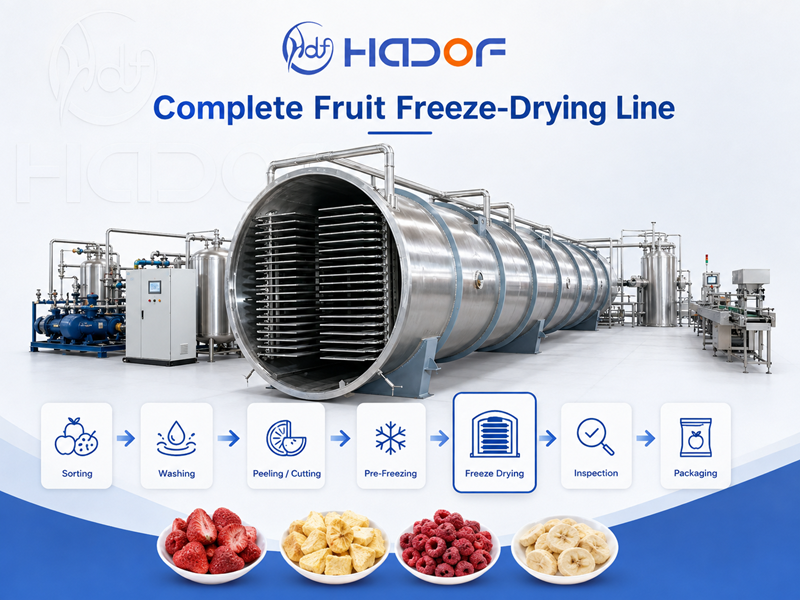
Mango, Strawberry or Banana: How Raw Material Changes Freeze-Drying Equipment Selection

Mango, strawberry, and banana can all enter a commercial freeze-drying line. However, each fruit brings different processing requirements. Texture, slice shape, moisture, loading method, and pre-freezing conditions can change the equipment configuration.

A suitable Fruit Freeze Dryer Machine should match your actual raw material and production target. Therefore, the right solution starts with the fruit rather than one fixed machine configuration.

Why Does Raw Material Affect Freeze-Drying Equipment Selection?

Fruit freeze drying removes frozen water under vacuum through sublimation. The process helps maintain fruit shape, color, flavor, and porous structure.

However, different fruits behave differently during preparation and drying. Soft fruit needs gentle handling, while dense slices require suitable thickness and freezing conditions.

Slice thickness also affects drying time. Therefore, your factory should coordinate washing, cutting, pre-freezing, drying, and packaging as one production system.

HADOF can configure the line according to your raw material, required capacity, and available factory space.

What Does Mango Require From a Freeze-Drying Line?

Mango usually enters the line as peeled slices, cubes, or pieces. Therefore, consistent cutting helps create more uniform batches.

Thick mango pieces need more time for heat and moisture transfer. Consequently, processors should control piece dimensions before loading trays.

The preparation section may include washing, peeling, cutting, and sorting. A Bubble Cleaning Machine can support continuous fruit washing before further preparation.

Mango processors should also consider tray loading carefully. Even product distribution helps the freeze dryer handle each batch more consistently.

For commercial production, a Commercial Fruit Freeze Dryer can match different batch targets through chamber and shelf configuration.

Why Does Strawberry Need Gentler Handling?

Strawberries have a soft structure and delicate appearance. As a result, aggressive handling can damage the fruit before freeze drying starts.

Whole strawberries and sliced strawberries also create different drying requirements. Thin slices provide a shorter moisture path, while larger pieces need more drying time.

Gentle washing becomes especially important. The bubble cleaning process uses water movement and bubbles to remove dirt while reducing mechanical damage. This approach suits delicate fruits such as strawberries.

After preparation, operators should move strawberries through the line with limited unnecessary handling. Food Conveyors can connect processing sections and support smoother material transfer.

Therefore, strawberry projects often focus on gentle cleaning, careful transfer, uniform loading, and controlled pre-freezing.

How Does Banana Change Equipment Configuration?

Bananas usually require peeling and slicing before pre-freezing. Consistent slice thickness helps each tray reach a more uniform drying result.

Banana pieces can also become soft during preparation. Therefore, the line should reduce unnecessary transfer between processing stages.

Factories with higher throughput may need stronger material-flow planning. Conveyors, loading areas, and tray preparation sections can reduce repeated manual movement.

Pre-freezing also plays an important role. An Industrial Tunnel Freezer can support continuous freezing when the production scale requires higher throughput.

The final machine selection should still follow batch capacity, shelf area, and factory layout.

Mango vs Strawberry vs Banana: What Changes Most?

Fruit Main Processing Focus Equipment Consideration
Mango Consistent pieces Cutting, tray loading, drying capacity
Strawberry Gentle handling Mild washing, careful conveying
Banana Uniform slices Cutting, pre-freezing, material transfer

These differences do not require three completely different production lines. Instead, they change the configuration around the core freeze dryer.

For example, one factory may need more preparation equipment for mango. Another may focus more on gentle strawberry handling. Meanwhile, a banana processor may prioritize slicing consistency and pre-freezing capacity.

Which Equipment Usually Stays in the Complete Line?

Although raw material changes the details, most commercial fruit lines follow a similar overall process:

Sorting → Washing → Peeling or Cutting → Pre-Freezing → Freeze Drying → Inspection → Packaging

The freeze dryer remains the central processing machine. Washing equipment prepares the fruit, while freezing equipment creates suitable frozen conditions before sublimation.

After drying, packaging protects the finished fruit from moisture. A Food Packing Machine can support the final packaging stage.

Therefore, buyers should consider the complete flow instead of viewing the freeze dryer as an isolated machine.

fruit freeze drying line

Does Production Capacity Matter More Than Fruit Type?

Both factors matter, but they influence different decisions.

Fruit type mainly affects pretreatment, slice size, handling, loading, and drying settings. Production capacity mainly affects chamber size, shelf area, refrigeration capacity, and material flow.

HADOF offers different industrial models for different production scales. The current fruit freeze dryer range includes HDF-30, HDF-50, HDF-100, and HDF-200 models. The listed capacities cover approximately 30 to 200 kilograms per batch.

However, customers do not need to prepare a complicated technical specification before asking for a solution. HADOF can match the equipment to your raw material, target output, and factory area.

How Should You Choose Between Different Fruit Projects?

Start with the product you actually want to sell.

For premium strawberry snacks, protect appearance and reduce rough handling. For mango pieces, focus on consistent dimensions and tray loading. For banana slices, coordinate cutting and pre-freezing carefully.

Next, match the required batch output with the freeze dryer capacity. Then, organize the washing, cutting, freezing, conveying, and packaging sections around that core machine.

This approach keeps the production line practical and avoids unnecessary equipment.

Build a Fruit Freeze-Drying Line Around Your Raw Material

Mango, strawberry, and banana can use the same freeze-drying principle. However, each material changes the preparation and equipment combination.

A well-planned project connects raw material characteristics with capacity and factory space. Therefore, the production line can support easier operation and more consistent output.

If you need a customized fruit freeze-drying solution, please visit the HADOF freeze dryer homepage:https://www.freezehadof.com/