The quality of raw limestone powder directly determines the stability, efficiency, and cost of lime-based fertilizer granulation. When customers choose suitable lime rock materials and control particle size, moisture, and purity, the granulation line runs more smoothly, and the resulting fertilizer granules show better strength, uniformity, and application performance. In contrast, unstable raw materials create frequent problems in lime pellet making procedures, such as low balling rate, excessive dust, and high equipment wear. Therefore, every fertilizer producer needs to treat raw material selection and preparation as a core part of the entire lime fertilizer manufacturing process, not as a simple preliminary step.
1. How Do Different Raw Materials Influence Lime Fertilizer Granulation in Various Industries?
Limestone-based fertilizer production does not only serve traditional agriculture. Many industries, including soil improvement, environmental treatment, and industrial by-product utilization, rely on lime or limestone powder granulation for stable and easy-to-handle products. Each industry faces different raw material requirements and obtains different benefits from optimized granulating conditions, therefore customers need to choose suitable lime rock sources and blending materials.
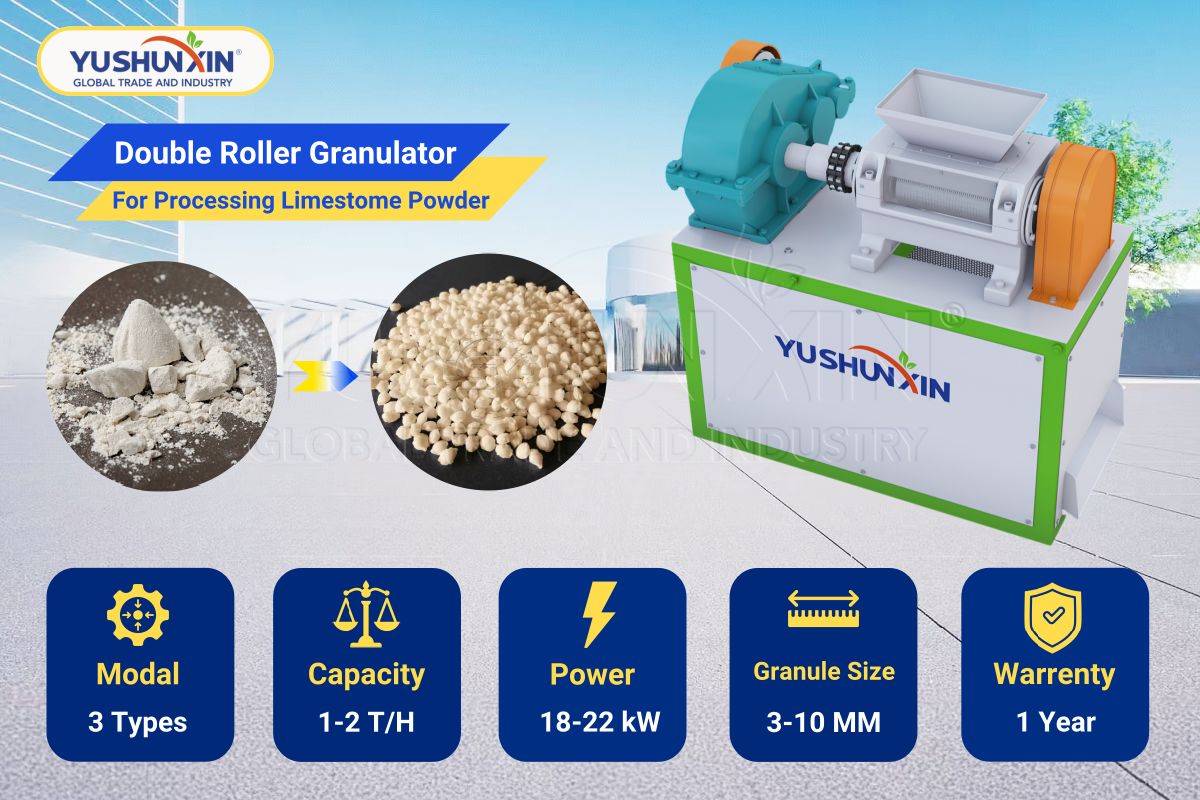
In soil conditioning and pH regulation, high-calcium limestone powder with moderate fineness usually supports consistent granule formation. When the particle size distribution remains stable, the double roller extrusion granulator compacts the material into uniform pellets with reliable crushing strength. This stability allows the rotary screening machine to separate qualified particles efficiently, while undersize and oversize granules return to the chain crusher and horizontal mixer for reprocessing. As a result, the overall production line keeps a balanced circulation, and fertilizer companies gain predictable output and lower recycle rates.
In environmental protection applications, such as desulfurization residue or industrial lime mud reuse, raw materials may contain more impurities and variable moisture. Producers in this area often choose to pre-treat the lime-based material with a loader type feeder and a controlled feeding system, because steady and homogeneous feeding reduces pressure fluctuations in the extrusion section. When the moisture, impurity content, and powder fineness remain under control, the dry granulation procedure through a double roller extruder can still form compact particles, even from challenging lime residue blends. This process helps waste recycling businesses convert unstable powder streams into valuable lime fertilizer pellets for land reclamation or mine restoration projects.
For compound lime fertilizer manufacturing, many companies blend limestone or dolomitic lime powder with nitrogen, phosphorus, and potassium sources. In this case, raw material compatibility and mixing uniformity become critical. The horizontal mixer needs consistent material behavior to create a homogenous preparation before the powder enters the pelletizer or double roller press. When the raw limestone features suitable fineness and low moisture, the granulation section produces high-density granules with well-distributed nutrients. Customers then obtain balanced NPK fertilizer products that improve crop nutrition management, although the core focus remains on granule formation performance rather than direct agricultural effects.
2. Why Does Raw Limestone Powder Quality Matter So Much for Granulation Efficiency and Product Performance?
The granulation process of lime-based fertilizer involves multiple tightly linked steps, including material feeding, crushing, mixing, compacting, shaping, screening, and packaging. Every step reacts to the physical and chemical properties of limestone powder. When raw materials meet stable quality standards, the entire production line reaches higher output and lower operating cost. Therefore, fertilizer plants regard raw material quality not as a theoretical concept but as a direct factor influencing profit and product reputation.
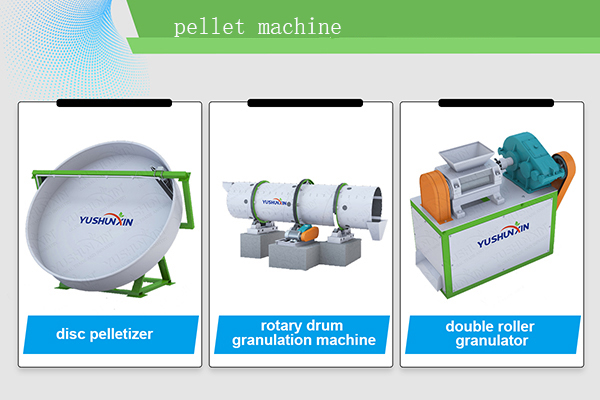
Particle size distribution of limestone powder strongly affects the granulating behavior. Very fine powder improves surface contact during double roller extrusion, so the compacted sheets or ribbons break into granules with good strength. However, excessively fine lime powder often increases dust load, causes poor flow in hoppers, and raises binder consumption. On the other hand, coarse lime rock particles may create voids inside granules, reduce density, and lead to easy breakage during rotary screening and belt conveyor transport. Consequently, many producers aim for a balanced limestone fineness range that matches the specific granulator, whether it is a dry compaction pelletizer, a ball making disc, or another type of granulation machine.
Moisture content also plays a crucial role. In dry granulation with a double roller extrusion granulator, lower and stable moisture allows the powder to compact effectively under pressure. If moisture fluctuates, the extruder may produce inconsistent sheets, leading to variable granule size and unsteady load on the rotary screening machine. In some lime fertilizer pelletizing lines, controlled moisture addition before mixing can enhance inter-particle bonding, but excessive water causes sticking problems inside the mixer, the press roll, and the screening equipment. Therefore, a stable moisture range helps customers maintain efficient operation and avoid unplanned cleaning and downtime.
Chemical composition and impurity levels significantly influence granule performance as well. High-purity limestone with predictable CaCO₃ content ensures consistent neutralizing value in the finished fertilizer particles. When producers apply such material, they can standardize granule size and nutrient content, so the automatic packaging scale fills bags with reliable product quality. If the raw lime rock contains clay, sand, or variable magnesium content, the granulation line may face problems such as roller surface wear, screen clogging, or uneven mechanical strength of pellets. High-quality raw materials therefore extend the lifetime of key machinery, including the double roller press, chain crusher, and belt conveyors, and reduce maintenance costs.
In addition, the choice of auxiliary materials and blending ratios interacts with limestone quality. Many fertilizer manufacturers combine lime powder with organic matter, micro-nutrients, or industrial by-products. When the base limestone powder remains uniform and stable, the horizontal mixer can form a consistent composite feed for subsequent granulation. The pellet making or compacting equipment then produces multi-component granules that still keep good shape, flowability, and storage stability. Customers who invest in careful raw material evaluation generally achieve stronger pellets, lower breakage in handling, and better market acceptance of their lime-based fertilizer products.
Conclusion
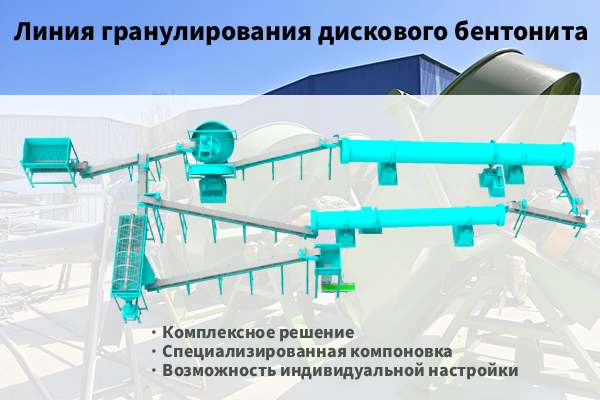
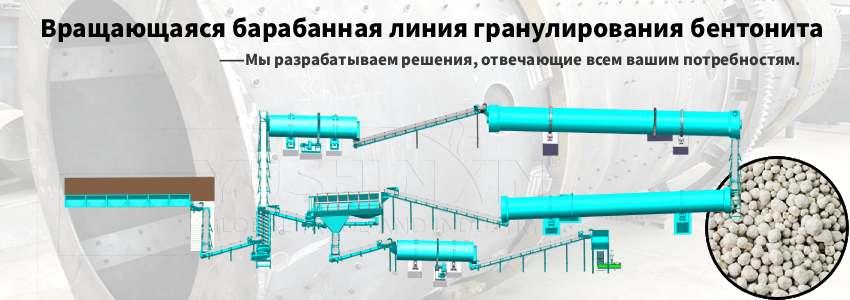
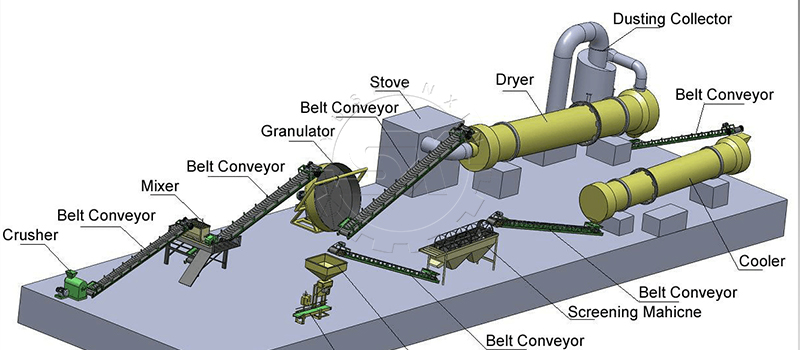
A complete limestone fertilizer granulation line usually integrates multiple units, such as a loader type feeder for stable supply, a chain crusher for size reduction, a horizontal mixer for homogenization, a double roller extrusion granulator for dry compacting, a rotary screening machine for particle size classification, belt conveyors for material transfer, and an automatic packaging scale for accurate bagging. When customers match suitable raw material quality with properly configured equipment, the lime fertilizer production process becomes more predictable, economical, and scalable.
For companies that plan to optimize lime rock powder granulation or upgrade existing production lines, cooperation with a professional fertilizer equipment manufacturer helps align raw material characteristics with suitable machinery selection and process design. A professional fertilizer equipment manufacturer – Yushunxin – offers support for limestone powder preparation, double roller dry granulation system configuration, and integrated lime fertilizer manufacturing solutions to help producers achieve stable, high-quality pellet output. You can visit: https://www.extruder-granulator.com/product/limestone-powder-granulation-machine/