A BB fertilizer manufacturing plant cost usually depends on the targeted capacity, the selected bulk blending process, and the chosen level of automation. A complete fertilizer plant setup often includes raw material preparation, weighing and batching, blending/mixing, conveying, and packing, so the budget must cover both core machinery and supporting equipment. In addition, the price and quotation for a BB/bulk blend/bulk blending line usually change with plant layout, workshop civil works, dust control configuration, and electrical control requirements. Therefore, an investor who plans to build and establish a fertilizer plant typically needs a clear cost breakdown that connects production goals with equipment configuration, especially because the blending/mixing procedure determines output stability, formula accuracy, and finished product consistency.
What cost items should a BB fertilizer plant setup budget include for bulk blending production?
A realistic budget for a BB fertilizer factory usually includes equipment cost, installation cost, workshop and infrastructure cost, and operating reserve. The machinery cost often covers an automatic/static batching machine, a BB fertilizer blender or drum type bulk blending mixer, a bucket elevator for feeding, and a packing machine for bagging. In addition, electrical cabinets, wiring, and basic sensors often influence the quotation because accurate dosing and stable blending require reliable control. The fertilizer manufacturing plant cost also includes steel platforms, material bins, and conveyor transitions, because a bulk blended fertilizer production procedure needs smooth material flow to avoid segregation and to protect weighing accuracy. Moreover, a fertilizer plant setup usually requires dust collection at transfer points, because bulk blend making and packing can generate fine particles. As a result, the total capital planning should combine machine price with auxiliary equipment and civil works, instead of focusing on only one blender or one mixer.
Which raw materials suit BB fertilizer production, and how do raw material choices affect the fertilizer plant cost?
Raw materials for BB/bulk blend fertilizer manufacturing usually include granular urea, ammonium sulfate, calcium ammonium nitrate, DAP, MAP, potassium chloride/MOP, potassium sulfate/SOP, and granular NPK compound fertilizer as a base component. In addition, some bulk blending formulations use micronutrient granules, such as zinc sulfate granules, boron granules, or magnesium sulfate granules, because uniform particle size supports consistent mixing. Raw material selection affects bb fertilizer manufacturing plant cost because some materials require pre-crushing or screening before the blending process. For example, caking or oversized particles can increase the need for a crushing machine, such as a vertical crusher or chain crusher, and that extra equipment changes the plant quotation. Furthermore, stable bulk blended fertilizer preparation often needs raw materials with compatible granule size ranges, because large differences in particle density or size can cause segregation after mixing and during bagging.
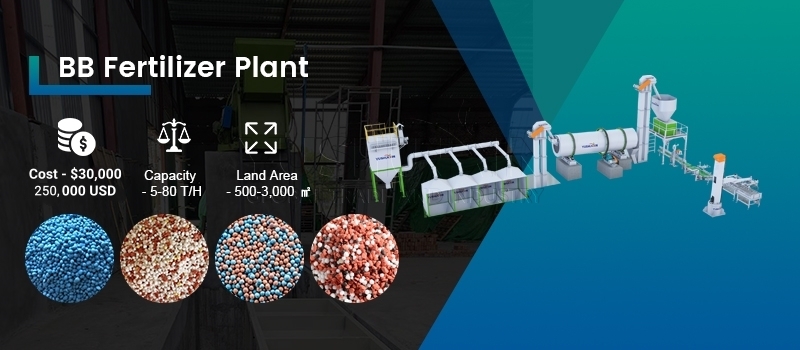
How does the blending/mixing process determine the machinery configuration and overall quotation for bulk blended fertilizer manufacturing?
The blending/mixing process represents the core of BB fertilizer production, so the mixer selection often drives the fertilizer plant cost. A small-to-medium BB fertilizer blender/mixer often suits a budget-oriented fertilizer production plant because it supports flexible formulas and quick changeovers, while a drum type BB fertilizer mixer often suits large-capacity bulk blending production because it provides continuous, stable throughput. In addition, an automatic/static batching machine improves formula accuracy during bulk blend preparation, and accurate batching reduces rework and raw material waste, which can protect long-term operating cost. A bucket elevator or belt conveyor usually connects batching to blending, and stable conveying reduces granule breakage that can create dust and reduce product quality. A packing machine with net-weighing functions also supports consistent bag weights, which influences the bb fertilizer factory cost through labor savings and reduced claims. Therefore, a detailed quotation should match the bulk blending procedure to the expected hourly output, the number of formulas, and the required weighing precision.
Conclusion
A practical estimate for how much capital is needed to establish a fertilizer plant should connect three factors: raw material condition, capacity target, and required automation level. A BB/bulk blend fertilizer production line usually centers on batching accuracy and mixing uniformity, so the blender or bulk blending mixer, the batching machine, the bucket elevator, and the packing machine often define the main fertilizer plant cost. In addition, crushing or double roller granulation can become necessary when raw materials require conditioning or when powder-to-granule production becomes part of the procedure, and those choices raise the total budget and quotation. A professional plan that classifies costs into core machinery, auxiliary equipment, and civil works typically delivers the most reliable fertilizer plant setup roadmap, and a professional fertilizer equipment manufacturer- Yushunxin can provide matched equipment configurations and project quotations for different bulk blended fertilizer manufacturing goals. You can visit: https://www.fertilizerproductequipment.com/bb-fertilizer-plant-cost/