Freeze drying preserves food by removing most of its water at low temperature, but the product is not finished when it leaves the drying chamber. Freeze-dried pieces are porous, light and hygroscopic, so poor packaging can quickly reverse the quality gains achieved during processing. Moisture uptake can soften the texture, oxygen can accelerate flavour loss, and physical compression can damage fragile fruit or meal components.
For commercial producers, packaging is therefore part of the process—not an afterthought. The right system combines a sufficiently low residual moisture level, a suitable barrier structure, reliable sealing and disciplined quality checks. This guide explains how to plan freeze-dried food packaging around the product, market and expected shelf life.
Why Freeze-Dried Food Needs Protective Packaging
The very structure that gives freeze-dried food its light, crunchy texture also makes it vulnerable. Ice sublimation leaves open pores that can absorb water vapour from the surrounding air. A brief exposure during transfer or sealing may not make the product visibly wet, but it can reduce crispness and increase the risk of caking, browning or microbial instability.
Packaging must address four main risks:
- Moisture vapour entering through the film or an incomplete seal
- Oxygen causing oxidation, aroma loss and colour changes
- Light accelerating deterioration in sensitive products
- Compression, abrasion and puncturing during transport
The required protection depends on the food. Whole freeze-dried strawberries need cushioning and protection from crushing, while coffee powder needs excellent aroma and moisture barriers. Freeze-dried meat or ready-meal components may require a different oxygen and moisture strategy from candy or fruit crisps.
Confirm Product Quality Before Packaging
No package can correct a product that was released with excessive residual moisture. Secondary drying should bring each batch to a moisture level suitable for the product and storage condition. Cooling and equilibration before packing also help reduce condensation risk.
Operators should verify product temperature, appearance, texture and moisture before the batch enters the packaging room. A documented release check is especially important when several recipes share the same industrial freeze dryer. The three-stage freeze-drying process provides the foundation, but packaging preserves that result.
Choose the Barrier Structure Carefully
Packaging films are usually selected as a multilayer structure. Each layer performs a different function: a sealant creates a strong closure, a structural layer provides strength, and a barrier layer limits moisture or oxygen transmission. Metallised film, aluminium-foil laminate, coated film and EVOH-containing structures are common options, but the final choice must match the product and testing method.
Do not select a film by thickness alone. Ask suppliers for moisture-vapour transmission rate, oxygen transmission rate, sealing range, puncture resistance and food-contact documentation. The bag format also matters. A flat pouch may be economical, while a stand-up pouch provides shelf presence and may protect fragile pieces better.
For long shelf life, the complete package must be considered:
- Film barrier performance and pinhole resistance
- Seal strength and seal contamination tolerance
- Zipper or easy-open reliability
- Headspace volume
- Carton or outer-case protection
- Storage temperature and humidity during distribution
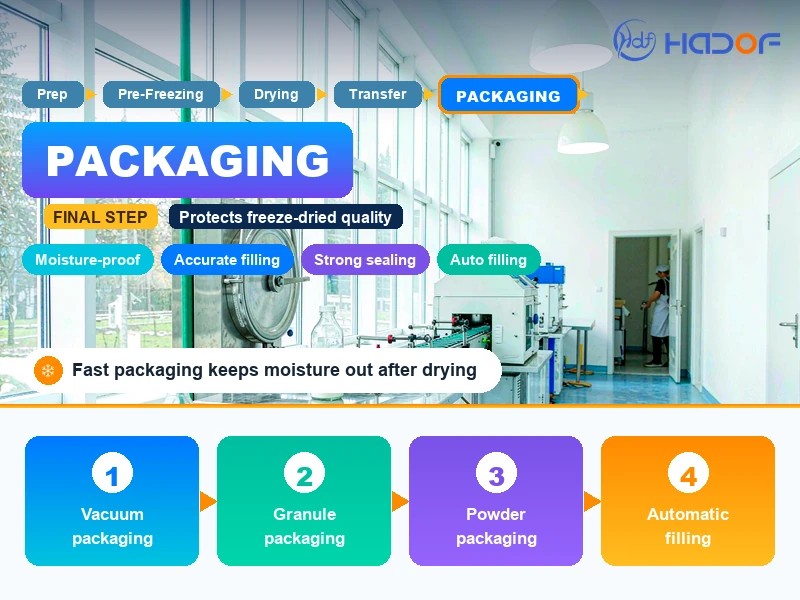
How Does Packaging Protect Freeze-Dried Products
Decide Whether to Use Nitrogen or Oxygen Absorbers
Nitrogen flushing displaces oxygen from the package headspace before sealing. It is useful for products that are sensitive to oxidation, but it requires controlled gas flow, reliable seals and routine oxygen measurement. Nitrogen is not a substitute for removing moisture; it mainly helps manage oxygen.
Oxygen absorbers can lower residual oxygen further, but they add a foreign object that must be handled and inspected correctly. They are not suitable for every product or package size. Vacuum packaging may also compress fragile pieces and change the desired texture, so it should be validated rather than applied automatically.
Run a packaging trial with the actual product, film, fill weight and sealing machine. Measure oxygen and moisture after sealing, then repeat the test after storage. This is more reliable than assuming that a “high-barrier” film will guarantee a particular shelf life.
Match the Packaging Machine to the Product
The best packaging equipment depends on whether the product is loose pieces, powder, granules or a regular-shaped item. A vertical film-roll machine can form bags and weigh loose pieces with a multi-head weigher. Powder systems use screw or vibration dosing, while pillow machines suit regular single pieces. In some projects, manual loading into pre-made pouches followed by automatic sealing is more practical than a fully automatic line.
Pay attention to the transfer point between drying and packaging. A closed conveyor or short controlled path reduces moisture exposure and handling damage. Stainless-steel contact surfaces, accessible cleaning areas and suitable filtration help protect food safety.
For a plant producing several products, a complete freeze-drying production line may combine tray handling, metal detection, weighing, filling, sealing, date coding and case packing. The investment should be justified by labour reduction, accuracy and consistent protection—not automation for its own sake.
Control Seals, Weight and Headspace
Seal quality is one of the most common causes of premature shelf-life failure. Heat-sealing temperature, pressure and dwell time must be validated for each film. Product dust or oil in the seal area can create channels that allow moisture to enter.
Operators should check seal appearance, seal width and opening strength at defined intervals. Leak testing, oxygen analysis and sample retention complete the release programme. Checkweighing protects net content and reduces giveaway, while metal detection or X-ray inspection addresses a separate but essential food-safety control.
Record the packaging settings for each product. A recipe that performs well for fruit pieces may damage delicate meal components or fail to control dust from a powder. Maintaining a product-specific setup reduces changeover errors.
Test the Finished Shelf Life
Shelf-life testing should include the real package, not an open sample. Store retained packs under normal and accelerated conditions where appropriate, then check moisture, texture, colour, flavour and seal integrity. Include transport simulation for export projects because vibration and compression can create pinholes that are not visible immediately after packing.
Define an acceptance standard before testing begins. “Still looks acceptable” is not enough; use measurable criteria such as moisture content, oxygen level, seal strength and sensory scores. This provides evidence for customers and helps compare packaging suppliers objectively.
Packaging Checklist for a New Product
- Confirm residual moisture and product release criteria
- Select a barrier film and bag format suitable for the product
- Validate nitrogen flushing or oxygen-absorber requirements
- Establish sealing temperature, pressure and dwell time
- Test seal strength, leak rate and headspace oxygen
- Verify label, lot code, allergen and storage instructions
- Run transport and shelf-life trials with production samples
- Retain samples from each batch for traceability
For a reliable freeze-dried product, packaging should be designed together with the dryer, product preparation and handling plan. HADOF Food Processing Manufacture can help match food packaging equipment and a complete freeze-drying solution to your product, output and shelf-life target.