How Does a Disc Granulator Machine Produce Uniform Mineral Fertilizer Granules?

A mineral fertilizer plant needs stable feed preparation and controlled wet granulation when the market requires round and relatively uniform fertilizer pellets. A mineral fertilizer disc granulator for commercial production creates granules through continuous rolling and layering inside an inclined rotating pan, so the finished particle size depends on raw-material fineness, moisture addition, disc angle, rotational condition and feed consistency rather than on the granulator alone.

What Mineral Fertilizer Raw Materials Suit Disc Granulation?

A disc granulation production line can process many powdered fertilizer materials when the formulation supports wet agglomeration. NPK fertilizer manufacturers commonly handle materials such as urea, ammonium sulfate, MAP, DAP, potassium chloride and potassium sulfate.

Mineral fertilizer projects may also process suitable powders from gypsum, zeolite, limestone-derived materials, phosphate minerals and other selected mineral sources. The mineral apatite, for example, relates closely to phosphate-bearing mineral resources and therefore appears in discussions around phosphate fertilizer raw-material preparation.

Organic-mineral fertilizer production may combine selected organic materials with mineral nutrients, but the plant should control moisture and pretreatment before granulation. A manufacturer should not feed large, wet or poorly mixed material directly into the pelletizing section because inconsistent feed can create irregular granule growth.

An industrial pan granulator for mineral fertilizer therefore works best as part of a coordinated fertilizer preparation process.
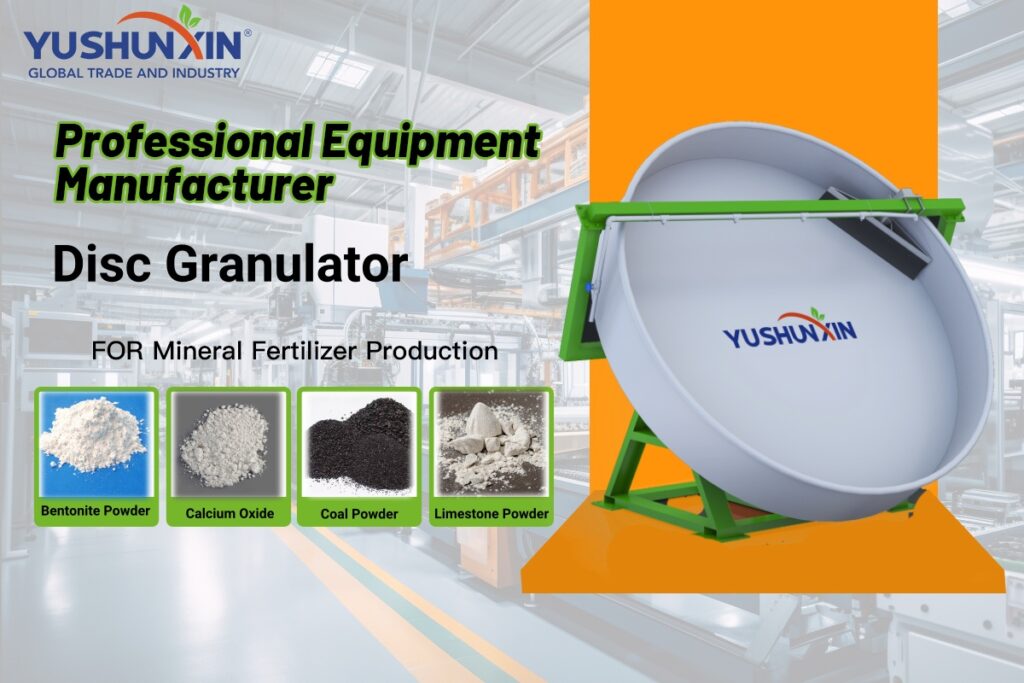
Disc Pelletizer for Mineral Fertilizer Production

How Does the Disc Granulation Process Build Fertilizer Pellets?

The rotating pan creates a moving material bed. Fine fertilizer powder enters the disc, while the process adds a controlled amount of liquid or binder when the recipe requires it. Small nuclei form first, and repeated rolling allows additional powder to attach to the growing particles.

The operator influences granule growth through feed rate, liquid addition, pan inclination and rotational behavior. Excess moisture can create oversized or sticky particles, while insufficient moisture can increase dust and fines. A stable fertilizer production procedure therefore requires the operator to coordinate these variables rather than adjust one parameter independently.

The plant should also maintain consistent raw-material fineness. Uneven powder size changes the surface area available for agglomeration and can increase the amount of undersize and oversize material.

A disc pelletizer for compound fertilizer manufacturing gives the production team visible control over the granulation bed, which can make the technology practical for fertilizer plants that handle multiple mineral or compound formulations.

Which Supporting Machines Improve Mineral Fertilizer Granulation?

A commercial line normally needs several preparation and quality-control stages around the granulator. Three additional machines often support the disc granulation section: a crusher, a fertilizer mixer and a rotary screening machine.

The crusher reduces coarse mineral feed to a more suitable size. The mixer distributes nutrient components before granulation. The screening machine separates the desired product fraction from fines and oversized granules after pellet formation.

These equipment sections should match the disc granulator capacity. An oversized granulator cannot deliver stable net output when the crusher or mixer supplies material inconsistently. The fertilizer machinery layout should therefore support continuous flow from raw-material preparation through granulation and classification.

The article on commercial mineral fertilizer granule production tips explains the wider connection between material preparation, granulation and downstream quality control.

How Can a Plant Improve Uniform Mineral Fertilizer Granule Size?

The production team should first stabilize feed composition. Frequent changes in moisture, particle size or nutrient ratio can change the behavior of the material bed inside the disc.

The team should then control liquid addition carefully. The fertilizer granulation process needs enough moisture to support agglomeration, but excessive liquid can increase sticking and oversized particles.

The operator should also maintain steady feeding. Sudden feed surges change the loading inside the disc and reduce particle-size consistency. Stable feeding supports a more predictable mineral fertilizer manufacturing process.

The plant should finally classify the finished granules and return suitable fines to the production system. A controlled recycle loop can improve raw-material utilization, although excessive recycle indicates that the upstream granulation parameters need correction.

What Factors Affect Disc Granulator Machine Cost and Investment?

A procurement decision should compare usable production capacity rather than only machine price. Disc diameter, drive configuration, material requirements, control level and the number of supporting machines all influence the final equipment quotation.

The project investor should also calculate crusher, mixer, screening, conveying, electrical and workshop costs where the project needs them. A low granulator purchase price does not guarantee a low fertilizer production cost when the surrounding system lacks capacity balance.

The correct mineral fertilizer granulation machine selection should therefore start with required output, raw materials, finished granule size and available factory space. Those parameters allow the supplier to design a more accurate mineral fertilizer production solution and investment budget.

When Does a Disc Granulator Fit a Mineral Fertilizer Project?

A disc granulator fits projects that need wet agglomeration of suitable mineral or compound fertilizer powders and that value flexible process adjustment. The technology can support small and medium fertilizer manufacturing projects as well as individual granulation sections in larger plants when the engineering team matches capacity correctly.

A producer should compare disc granulation with rotary drum or dry roller granulation when raw-material behavior or output requirements change significantly. The best fertilizer production technology depends on the feedstock and final product rather than a universal machine ranking.

The procurement team can learn more about the target equipment before requesting a project quotation. For a configured production proposal, A professional fertilizer equipment manufacturer can support mineral fertilizer equipment selection after the buyer confirms the material and required capacity.

https://www.mineralfertilizerproductionsolutions.com/product/disc-granulator-machine/

Comparing Disc Granulators with Other Granulating Machines in Mineral Fertilizer Production

In the mineral fertilizer industry, producing high-quality granules is essential for efficient application and optimal crop growth. Granulation equipment plays a crucial role in transforming raw mineral materials into uniform fertilizer particles. This article explores how disc granulators compare with other granulating machines in the context of ore processing, helping you make informed decisions for your fertilizer manufacturing needs.

What Raw Materials Are Used in Mineral Fertilizer Production?

Mineral fertilizer production utilizes a variety of raw materials derived from rocks and ores. Common examples include rock phosphate, which provides essential phosphorus; potash ores containing potassium; limestone used for calcium content; and mined sulfur for sulfur-based fertilizers. Each of these minerals offers specific benefits to different crops and soil types, supporting industries ranging from agriculture to horticulture. Selecting the appropriate raw materials depends on the nutritional requirements of the target industry and the desired fertilizer composition.

Disc Pelletizer for Mineral Fertilizer Production

How Does a Disc Granulator Work in Ore Processing?

A disc granulator, also known as a pan granulator or disc pelletizer, is a key machine in transforming powdered mineral materials into granulated fertilizer products. It operates by rotating a disc at a controlled angle, causing the raw materials to tumble and coalesce into granules through the addition of a binding agent and moisture. This granulation process allows for precise control over particle size and density, resulting in uniform mineral fertilizer granules. The disc granulating machine is valued for its simplicity, efficiency, and ability to handle a wide range of mineral ores.

What Are the Alternatives to Disc Granulators in Mineral Fertilizer Granulation?

In addition to disc granulators, the mineral fertilizer industry employs other granulating equipment such as drum granulators and extrusion granulators. Drum granulators, or rotary granulators, use a rotating drum to agglomerate materials, suitable for large-scale production but with less control over granule size. Extrusion granulators force materials through a die, forming granules under high pressure, ideal for materials with specific binding properties. Comparing these machines, each offers unique advantages in terms of production capacity, granule uniformity, and suitability for different mineral ores.

Why Choose a Disc Granulator for Mineral Fertilizer Manufacturing?

Selecting a disc granulator for mineral fertilizer manufacturing provides several benefits. The disc granulation process offers excellent control over granule size, essential for consistent fertilizer application. Disc pelletizers are especially effective with materials like rock phosphate and other mineral powders, ensuring thorough mixing and granule formation. Additionally, the flexibility in adjusting the disc angle and rotational speed allows for customization based on specific ore characteristics. Compared to other machines, disc granulators often have lower operational costs and are easier to maintain, making them a practical choice for many producers.

What Other Machinery Is Essential in Mineral Fertilizer Production Lines?

A complete mineral fertilizer production line involves more than just granulating equipment. Crushing machines, such as jaw rock crushers or ore fertilizer crusher machines, are necessary to reduce mineral rocks into smaller particles for processing. Screening machines play a crucial role in separating qualified granules from oversized or undersized particles, ensuring product quality. Other equipment like mixers and dryers may also be integrated into the production process. Combining these machines effectively contributes to efficient mineral fertilizer manufacturing, whether producing limestone fertilizers, NPK blends, or managing mine waste for fertilizer use.

Conclusion

Understanding the different types of granulating equipment is vital for optimizing mineral fertilizer production. A disc granulator offers distinct advantages in granule quality and operational efficiency compared to other machines. Incorporating the right machinery, including crushers and screening equipment, ensures a streamlined production process suitable for various mineral ores and rock-based fertilizers. For reliable and professional support in setting up your fertilizer production line, consider partnering with a reputable manufacturer like Yushunxin. You can visit: https://www.mineralfertilizerproductionsolutions.com/product/disc-granulator-machine/

Who Are the Ideal Customers for Raymond Mills in the Mineral Fertilizer Market?

What Raw Materials Are Suitable for Raymond Mills?

Raymond mills offer significant versatility in the processing of various raw materials. These mills efficiently grind and pulverize minerals into fine, uniform powders. Common raw materials include limestone, phosphate rock, gypsum, and potassium feldspar, all essential components in the production of mineral fertilizers. Their ability to handle materials with varying hardness and moisture levels makes Raymond mills indispensable in the mineral fertilizer market.

Why Should Large-Scale Agricultural Producers Consider Raymond Mills?

Large-scale agricultural producers require reliable, efficient machinery to meet the high demands of modern farming. Raymond mills provide a cost-effective solution for grinding essential minerals that enhance soil fertility. By utilizing these mills, agricultural producers can improve crop yields and overall farm productivity. The ability to produce fine, consistent powders ensures even distribution of minerals in the soil, leading to optimized nutrient absorption and plant growth.

Large Capacity of Raymond Mill

What Do Fertilizer Manufacturers Gain from Using Raymond Mills?

Fertilizer manufacturers benefit significantly from the precision and efficiency of Raymond mills. These mills enable the production of high-quality, uniform mineral powders essential for creating balanced fertilizer blends. Consistent particle size ensures that each fertilizer batch meets stringent industry standards, enhancing product reliability and market competitiveness. Additionally, the mills’ energy-efficient operation reduces production costs, offering long-term economic benefits.

How Can Industrial Mineral Processors Utilize Raymond Mills?

Industrial mineral processors find Raymond mills invaluable for refining raw minerals into marketable products. The mills’ adaptability to various mineral types and processing conditions enhances operational flexibility. Processing minerals such as dolomite, barite, and talc becomes straightforward with Raymond mills, ensuring high throughput and consistent product quality. The machinery’s robust design allows for continuous, heavy-duty operation, meeting industrial-scale demands efficiently.

What Features Make Raymond Mills Suitable for Diverse Needs?

Raymond mills boast several features that cater to the needs of large-scale agricultural producers, fertilizer manufacturers, and industrial mineral processors. The mills offer adjustable grinding settings, allowing for precise control over the final particle size. Their high grinding efficiency and low energy consumption make them a cost-effective choice. Additionally, the mills’ durable construction ensures longevity and minimal maintenance, providing reliable performance over extended periods.

Conclusion

Choosing the appropriate machinery is crucial for anyone involved in the mineral fertilizer market. Raymond mills stand out for their ability to handle a wide range of raw materials, achieving consistent, high-quality outputs that meet diverse industry needs. Agricultural producers, fertilizer manufacturers, and industrial mineral processors all benefit from the reliability, efficiency, and versatility of these mills.

Yushunxin, a professional fertilizer equipment manufacturer, offers Raymond mills designed to meet the specific demands of mineral fertilizer production. Investing in the right equipment ensures operational efficiency, product quality, and long-term profitability. Contact Yushunxin today to learn more about how their advanced machinery can support your production goals. Visit: https://www.mineralfertilizerproductionsolutions.com/product/raymond-mill/