In a high-capacity freeze-drying line, the drying chamber gets most of the attention, yet the pre-freezing step decides how hard that chamber can actually work. Sublimation only begins once every product core is fully frozen, so any delay or unevenness upstream of the chamber turns directly into idle shelf time. When you plan a 100kg/batch industrial freeze drying plant, the pre-freezing strategy you choose shapes waiting time, batch turnover, and the rhythm of the entire line.
Pre-Freezing Sets the Pace of the Whole Line
If trays freeze inside the drying chamber, the chamber spends part of every cycle as a freezer. Shelves cool down, hold the product until the core temperature reaches its target, and only then heat up again to start sublimation. That sequence stretches each cycle and keeps the most expensive asset in the line busy doing work that cheaper equipment could handle.
Off-line pre-freezing breaks this pattern. Product arrives at the chamber already frozen, shelves load immediately, and vacuum pulls down within minutes of loading. The chamber then spends its full cycle doing what it does best: drying. The goal is simple — the freezing section finishes exactly when the chamber becomes available, so no trays wait in the aisle and no chamber sits empty.
Tunnel Freezing: Steady Capacity for Tray-Based Loading
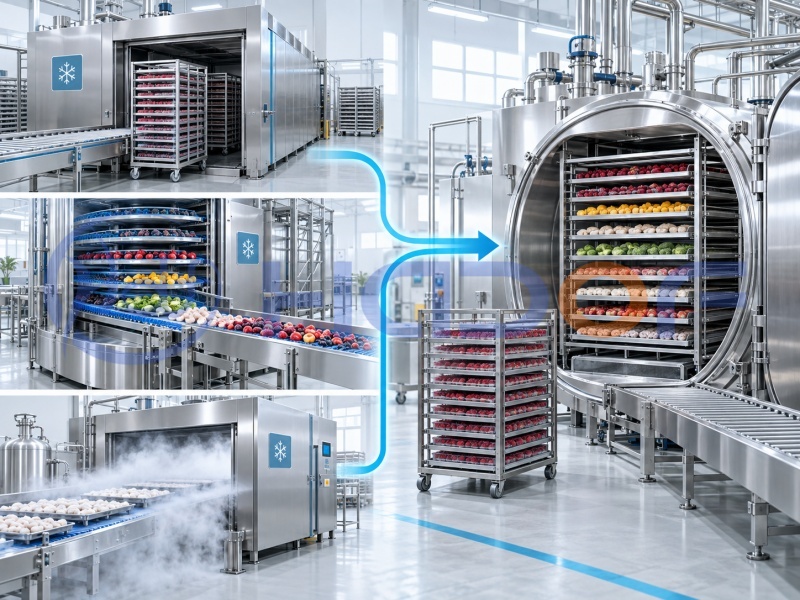
An industrial tunnel freezing machine moves trolleys of loaded trays through a cold tunnel on a fixed schedule. It matches tray-based freeze drying naturally: the same trays that load the tunnel can carry product straight to the chamber shelves, which cuts handling and keeps tray depth consistent between the two stations. Tunnel freezing suits factories that run repeatable batch patterns and want a straightforward, robust freezing stage with simple maintenance.
IQF Spiral Freezing: Continuous Flow for Loose Products
An IQF spiral freezing machine freezes individual pieces as they travel along a spiral belt, giving a continuous stream of loose-frozen product — dice, slices, berries, shrimp. Because pieces freeze separately, they do not clump, so they spread evenly across trays at the loading station and vapor escapes uniformly during drying. For high-volume vegetable and fruit lines, IQF keeps the feed side flowing at the same pace the chamber consumes it.
Liquid Nitrogen Quick Freezing: Speed for Demanding Loads
A liquid nitrogen quick freeze machine freezes product faster than any mechanical option. The rapid crust locks cell structure and surface appearance, which matters for high-value fruits, dairy pieces, and delicate prepared foods. Speed also serves line rhythm: when a chamber frees up ahead of schedule, liquid nitrogen freezing lets the next batch catch up instead of leaving shelves idle. Factories weigh the higher operating cost of cryogen against the value of faster turnaround and premium product quality.
Match Freezing and Drying as One System
Each freezing route changes what happens downstream: freezing method affects how product spreads on trays, how vapor leaves the load, and how predictably each batch reaches its end point. A 100kg/batch freeze drying plant only delivers its full capacity when the freezing section upstream keeps the same pace, so both stations deserve planning attention together. A line works best when freezing capacity, transfer time, and chamber batch size grow together instead of one station racing ahead of the rest.
Hadof builds freezing, drying, and handling sections as one coordinated line, sized to your raw material, output target, and factory floor. To discuss a customized high-capacity solution for your products, visit the Hadof freeze dryer homepage at https://www.freezehadof.com/