What Factors Influence the Efficiency of Extrusion Granulation in Lime Powder Processing?

In modern fertilizer engineering, extrusion granulation plays a decisive role in improving product quality and optimizing production efficiency. When industries use lime powder or limestone materials to prepare compound fertilizers, several interrelated factors determine the performance of the granulating process. The following discussion explores these influential elements from raw material selection to equipment configuration, leading to a professional understanding of lime-based fertilizer granule manufacturing.


1. What Types of Raw Materials Affect the Performance of Lime Powder Fertilizer Granulation?

The efficiency of extrusion granulation depends largely on the chemical and physical nature of raw materials. Lime powder, limestone, and lime rock with moderate fineness and balanced moisture content provide better compacting and forming properties. When used as a calcium supplement in fertilizer manufacturing, they help neutralize soil acidity, promote nutrient absorption, and enhance particle hardness. The construction material industry often prefers finely milled lime powder for consistent granule strength, while the environmental sector benefits from using lime rock granules for wastewater treatment adsorbents.

When combining lime-based materials with additional mineral sources such as phosphate rock or magnesium oxide, the granulation process achieves a more uniform mix, which directly affects extrusion pressure and granule uniformity. Therefore, the choice and proportion of each material significantly influence the energy consumption, extrusion force, and granule durability. Balanced material composition ensures that the final lime fertilizer particles maintain stable physical structure during storage and transportation.
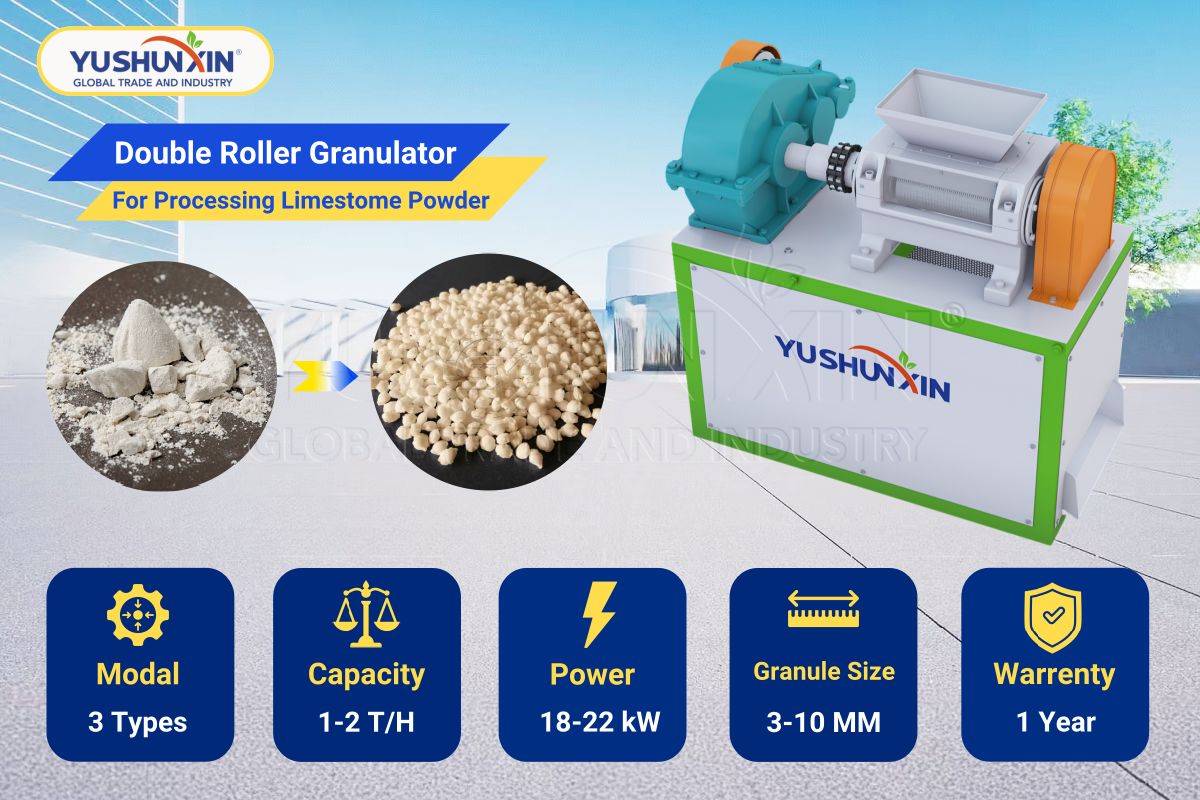
Limestone Powder Granulator

2. How Do Machine Configurations and Granulating Techniques Improve Lime Fertilizer Production Efficiency?

In lime powder fertilizer preparation, machinery selection determines the consistency and efficiency of granulation. A loader-type feeder supplies raw materials evenly, ensuring continuous feed during production. A crane crusher refines large limestone lumps into smaller, easily mixable particles. The horizontal mixer then blends lime powder with other additives, forming a uniform base for extrusion.

The double roller extrusion granulator serves as the core of the system. This equipment compacts dry materials under high pressure, forming dense granules without the need for additional moisture or heat. Such dry granulation or compacting procedure reduces drying time and energy consumption while improving product uniformity. After extrusion, the rotary screening machine separates qualified pellets from oversized or undersized ones. Belt conveyors transfer the sorted materials to the automatic packaging scale, completing an efficient and automated fertilizer production line.

These interconnected machines maintain stable operation and precise control of particle size distribution. By adjusting roller gap, pressure, and feeding speed, operators can optimize granule density and surface smoothness. Consequently, industries processing lime powder fertilizers achieve higher mechanical strength and reduced dust generation during handling.


3. Why Do Operating Parameters and Production Environment Determine the Stability of Lime Granulation?

Stable granulating performance requires balanced operational conditions. Extrusion pressure, roller temperature, and feed rate must match the physical characteristics of lime powder. If the pressure is too low, granules may remain loose; if too high, they may crack. Controlled humidity prevents agglomeration while allowing smooth particle release from the press rollers.

Moreover, the cleanliness of the production environment influences mechanical wear and product quality. Dust accumulation around the extruder or pelletizer can cause uneven feeding and equipment abrasion. Regular maintenance of the granulation machinery ensures consistent compacting performance, extending service life and reducing downtime. For large-scale lime powder fertilizer manufacturing, automated control systems enable accurate parameter adjustment, further improving efficiency and reducing labor intensity.


4. Comprehensive Understanding and Industrial Implications

Extrusion granulation in lime powder fertilizer production represents a delicate balance between raw material properties, mechanical design, and operational management. Proper coordination among these aspects ensures high-efficiency particle formation, stable product size, and reduced environmental impact. Industries that process limestone-based fertilizers can enhance competitiveness through continuous improvement of their granulating process, adopting advanced equipment and optimized technology to achieve consistent quality.

A professional fertilizer equipment manufacturer—Yushunxin—provides integrated solutions for lime powder granulation, from raw material feeding to automatic packaging. The company’s expertise in double roller extrusion systems and supporting machinery helps industrial users build efficient, durable, and sustainable fertilizer production lines tailored to diverse material requirements and process goals. You can visit: https://www.extruder-granulator.com/product/limestone-powder-granulation-machine/

How to Produce 10 T/H NPK Fertilizers Using Dry Granulation Techniques?

Which Raw Materials Suit 10TPH Extrusion Granulation Line for NPK Fertilizers?

Producing NPK fertilizers through dry granulation techniques such as press or compact granulation requires the selection of suitable raw materials. The primary materials commonly used include ammonium nitrate, urea, ammonium sulfate, potassium chloride, and monoammonium phosphate. High-quality raw materials ensure that the granulation process achieves optimal efficiency and product quality.

In agriculture, ammonium nitrate provides a quick nitrogen release, crucial for fast-growing crops. Urea offers a higher nitrogen concentration, beneficial for crops requiring prolonged nitrogen supply. Ammonium sulfate not only supplies nitrogen but also sulfur, which enhances soil fertility. Potassium chloride is essential for potassium-deficient soils, boosting plant growth. Monoammonium phosphate provides both nitrogen and phosphorus, essential for root development and flowering. Each material supports specific agricultural needs, leading to increased crop yields and soil health.

NPK Materials for Double Roller Extruder

What Machine Features Enhance the Granulation Process for NPK Fertilizers?

A successful 10 TPH NPK granulation line integrates several machines, starting with the loader type feeder, which ensures a consistent and controlled feed of raw materials into the system. The crain crusher reduces the raw materials to a fine powder, enhancing the mixing process. The horizontal mixer thoroughly combines the different powders, ensuring uniformity in the final product.

The double roller extrusion granulator, also known as a compact or press granulator, plays a pivotal role by compressing the mixed powders into solid granules without the need for a liquid binder. This dry granulation technique is efficient and reduces energy consumption. The rotary screening machine separates the granules by size, ensuring only the desired granule size progresses further. The automatic packaging scale measures and packages the finished product accurately, while belt conveyors facilitate the smooth transfer of materials between different stages of the process.

Why Choose Advanced Equipment for NPK Fertilizer Production?

Advanced equipment offers numerous benefits for 10 t/h NPK fertilizer production. The loader type feeder ensures a steady input flow, preventing blockages and downtime. The crain crusher efficiently reduces particle size, which is crucial for uniform mixing. The horizontal mixer ensures all components are evenly distributed, preventing nutrient imbalances in the fertilizer.

The double roller extrusion granulator provides a robust and reliable granulation method that eliminates the need for a drying phase, thus saving energy and reducing operational costs. The rotary screening machine ensures that only granules of the correct size are selected, maintaining product quality and consistency. The automatic packaging scale enhances operational efficiency by precisely measuring and packaging the final product. Belt conveyors streamline the entire production process, reducing manual handling and associated risks.

Double Roller Granular NPK Fertilizer Production Line

What Are the Benefits of Using Advanced Equipment in Different Industries?

In agriculture, using advanced granulation equipment ensures the production of 10 tons high-quality NPK fertilizers per hour, which leads to better crop yields and soil health. Consistent and precise nutrient distribution minimizes wastage and maximizes efficiency. Industrial users benefit from the energy-efficient dry granulation process, which lowers operational costs and enhances sustainability.

Livestock farming industries that utilize NPK fertilizers for pasture improvement can also achieve significant benefits. High-quality granules ensure uniform nutrient application, promoting healthier pastures and better livestock nutrition.

Transition to the Expertise of a Renowned Fertilizer Equipment Manufacturer

When seeking reliable and advanced machinery for NPK fertilizer production, choosing the right manufacturer is crucial. A professional fertilizer equipment manufacturer, such as Yushunxin, provides state-of-the-art machinery tailored to meet the specific needs of various industries. Their expertise ensures the production of high-quality fertilizers, contributing to agricultural success and sustainability. By partnering with Yushunxin, industries can achieve optimal production efficiency and superior product quality, ensuring they remain competitive in the market. You can visit: https://www.extruder-granulator.com/10-t-h-npk-fertilizer-granulation-line/

How to use double roller pelletizer to make 10 t/h limestone pellets

Introduction to Double Roller Pelletizer

The roller pelletizer is a machine used to produce pellets from various materials, including limestone. It is an efficient and cost-effective way to create high-quality pellets for various applications. The double roller pelletizer works by pressing the material through two rollers that rotate in opposite directions, creating pressure and heat that forms the pellets.

Preparing Limestone for Pelletizing

Before using the double roller pelletizer to make limestone pellets, it is important to prepare the material properly. This involves crushing the limestone to a fine powder and ensuring that it is free from any impurities. The limestone should also be dried to remove any moisture, as this can affect the quality of the pellets.

Setting Up the Double Roller Pelletizer

Once the limestone is prepared, the next step is to set up the double roller pelletizer. This involves adjusting the rollers to the correct size and shape for the desired pellet size. The rollers should be set to a pressure that is high enough to create a strong pellet, but not so high that it causes the material to crumble.

Using the Double Roller Pelletizer

To use the double roller pelletizer, the prepared limestone is fed into the machine at a steady rate. The rollers press the material together, creating heat and pressure that forms the pellets. The pellets are then ejected from the machine and can be cooled and collected for use.

Achieving 10 t/h Production Rate

To achieve a production rate of 10 t/h with the double roller pelletizer, it is important to optimize the machine’s settings and ensure a consistent feed rate. This may involve adjusting the speed of the rollers, the pressure, and the size of the pellets. It is also important to regularly maintain the machine to ensure it is running at peak efficiency.

Conclusion

The double roller pelletizer is an effective and efficient way to produce limestone pellets. By properly preparing the material, setting up the machine, and optimizing its settings, it is possible to achieve a production rate of 10 t/h. With regular maintenance and careful operation, the double roller pelletizer can produce high-quality pellets for various applications.