Freeze-Dried Soup and Ready Meal Ingredients: A Production Line Guide
Instant soups, ready meals, and convenience foods all depend on ingredients that are light, stable, and fast to rehydrate. Freeze-dried vegetables and other ingredients deliver exactly that. They keep their shape, color, and nutrients, rehydrate in minutes, and can be stored at ambient temperature for years. For food factories supplying the ready-meal and soup market, a dedicated freeze-drying line is a way to add value to fresh produce and build a reliable ingredient business.
Why Freeze-Dried Ingredients
Conventional drying can shrink vegetables, darken their color, and drive off aroma. Freeze drying removes water at low temperature, so the product keeps its original structure and much of its nutritional value. When the ingredient is added to a soup or ready meal, it rehydrates quickly and closely resembles the fresh material. Because the finished product is very light, shipping and storage costs drop sharply, which matters for both domestic distribution and export.
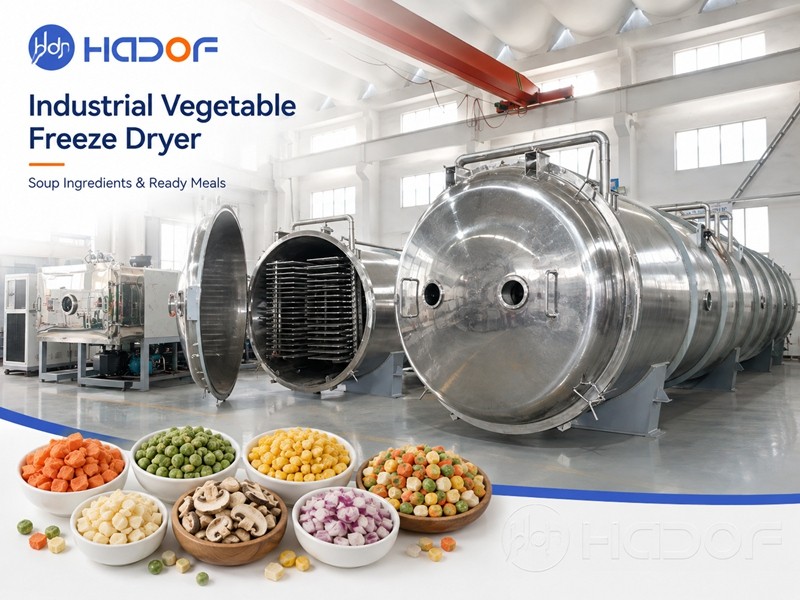
Industrial Vegetable Freeze Dryer for Soup Ingredients & Ready Meals
The Production Process
A freeze-dried soup and ready-meal ingredient line usually follows this sequence:
- Receiving and washing — fresh vegetables are inspected and washed.
- Cutting and size reduction — product is sliced or diced to a uniform size.
- Blanching — a short heat step stabilizes color and enzymes.
- Pre-freezing — the product is frozen quickly to protect texture.
- Vacuum freeze drying — ice sublimates directly to vapor at low temperature.
- Sorting and packaging — dried ingredients are checked and packed in barrier packaging.
Each step affects the next. Uneven cutting leads to uneven drying, and poor blanching can leave the product with off-colors or poor rehydration.
Equipment for the Line
The core of the line is the industrial vegetable freeze dryer, sized around the batch weight and shelf area your product needs. Around it, the line needs washing equipment, cutting and dicing machinery, a blanching machine, a pre-freezer, and a packing machine. For factories that also process fruit, the same line can often handle both categories with recipe and tray changes.
Pre-processing deserves attention. A bubble washer, brush roller cleaner, or vibrating dewatering machine improves product quality and reduces water load before drying. Cutting equipment should produce a consistent size so that every piece dries at the same rate. A blanching machine stabilizes color and texture before freezing.
Capacity and Configuration
Capacity is usually specified by batch weight or shelf area. Producers often start with a batch size that matches their fresh-produce supply and then add capacity as demand grows. The right size depends on your product mix, drying cycle, and target output. Under-sizing the dryer leaves product waiting and risks quality loss; over-sizing raises running costs. A practical approach is to size the industrial freeze dryer to a comfortable daily batch and plan the building so a second unit can be added later.
For producers who want a complete solution, a freeze-dried vegetable production line combines washing, cutting, blanching, freezing, drying, and packing into one coordinated flow. That reduces handling, improves consistency, and makes the line easier to manage.
Quality Control
Quality control starts with the raw material. Vegetables should be fresh, firm, and consistent in size. Blanching times and temperatures must be controlled so the product keeps its color without becoming soft. The freeze-drying process should be logged for pressure, shelf temperature, and cycle time, and finished ingredients should be tested for moisture, color, and rehydration. Hygiene and traceability are essential, because these ingredients go into food products sold to consumers.
Common Mistakes to Avoid
The first mistake is cutting vegetables to inconsistent sizes, which leads to uneven drying. The second is skipping or over-doing blanching, which affects color and texture. The third is overloading trays, which blocks vapor flow and lengthens the cycle. The fourth is freezing too slowly, which produces large ice crystals and damages structure. Finally, poor packaging lets the ingredients absorb moisture and lose their crisp texture. A well-designed line and a simple quality checklist prevent most of these problems.
Conclusion
Freeze-dried vegetables and ingredients are a practical way to supply the growing soup and ready-meal market with high-quality, shelf-stable components. The line is straightforward — wash, cut, blanch, freeze, dry, and pack — but each stage must be designed around the product. HADOF Food Processing Manufacture designs complete production lines for freeze-dried soup and ready-meal ingredients, from pre-processing to the freeze dryer and packaging. Tell us your product and target output, and we will help you plan the right line.